Kia ora, ko Greer tōku ingoa.
For my PhD at Otago University I am researching admiral butterflies in NZ: kahukura (NZ red admiral), Rēkohu kahukura subspecies (Chatham Island red admiral), and kahukōwhai (yellow admiral).
I’ve been gathering parasitisation data in Ōtepoti (Dunedin) and the result from last year was concerning, with a 94.4% (68/72) wasp parasitisation rate of chrysalises!
Parasitisation data across the country would be so valuable. Can you help me with this project?
The aim is to create a map of parasitisation rates across different nettle species and nationwide. This data is important for conservation and funding for research in the future to focus on developing ways to get rid of the introduced wasps that attack our beautiful native butterflies. None of these wasps can hurt people so it’s also a fun activity and important citizen science project.
• Find an open place of any size. You need maximum sun, shelter, and an area which will not need intensive management.
• No pesticides allowed!
• Plant (or maintain) shelter on the SW side (or wherever the prevailing wind is coming from) but never on the northern side which might block the sun.
• Shelter trees such as Olearia spp, Houhere, Coprosma spp, Hebe/Veronica spp, Muehlenbeckia complexa (scrambling pohuehue) will protect the habitat. These might be used for overwintering, as host plants or as a nectar source.
• Shrubs such as Pimelea spp, Mahoe, Brachyglottis spp, Pseudopanax spp, and Helichrysum spp. support useful NZ moth species as well as other native insects.
• Plant Urtica ferox (Ongaonga) in places where the plants are generally inaccessible to humans and pets (to deter people from being stung), such as away from paths. This is the host plant for the red admiral butterfly.
• Plant Carmichaelia spp. and Tagasaste/tree lucerne (hosts for blue butterflies) as well as Pittosporum, Gahnia and Astelia, hosts for many moth species.
• Plant Muehlenbeckia spp. around the U. ferox to provide food for the copper butterflies as it can act as a barrier as well.
• Plant single (open face) dahlias and mature swan plants (at least six months old) if you are in a frost-free area or after the last frost on the sunny side of the "barrier". Add masses of annuals such as swan plants, tropical milkweed, cosmos, zinnias and Tithonia speciosa ‘Goldfinger’ on the sunniest side.
• Plant Muehlenbeckia axillaris (mat pohuehue) around stony ground and leave bare patches – talk to the MBNZT about a translocation of boulder coppers from a nearby location.
• Plant prostrate broom (Carmichaelia appressa) plus clover around the edges of paths. Also encourage medicago and lotus, generally seen as weeds. All these plants make excellent habitat for the blue butterflies.
• In nearby garden beds include annual dahlias, tropical milkweed, cosmos and zinnias and any other flowering plants you see pollinators visiting.
• Look for other plants locally where butterflies and moths are found. They could be added to your habitat. If buying plants, choose older varieties and not the new hybrids.
• Share details of what you’ve planted and why with visitors to your habitat and the MBNZT. We will be happy to spread the word.
• Enjoy!

Coffee break for Jeannette and Harvey Dent
Since November 2023 my dog, Harvey Dent, and I are out and about on my mobility scooter in the beautiful Whāngarei parks every day, so I have now seen the annual cycle of plantings of the flower beds here.
I told Jacqui I’d like to do more to help our pollinators thrive, because I believe local government could be encouraged to focus on more nectar-producing flowering plants in their public places. So I got together with Lynda Emery and Jacqui and we’ve been working on a project which has morphed from “Help our Pollinators Thrive” to the Public Places project.
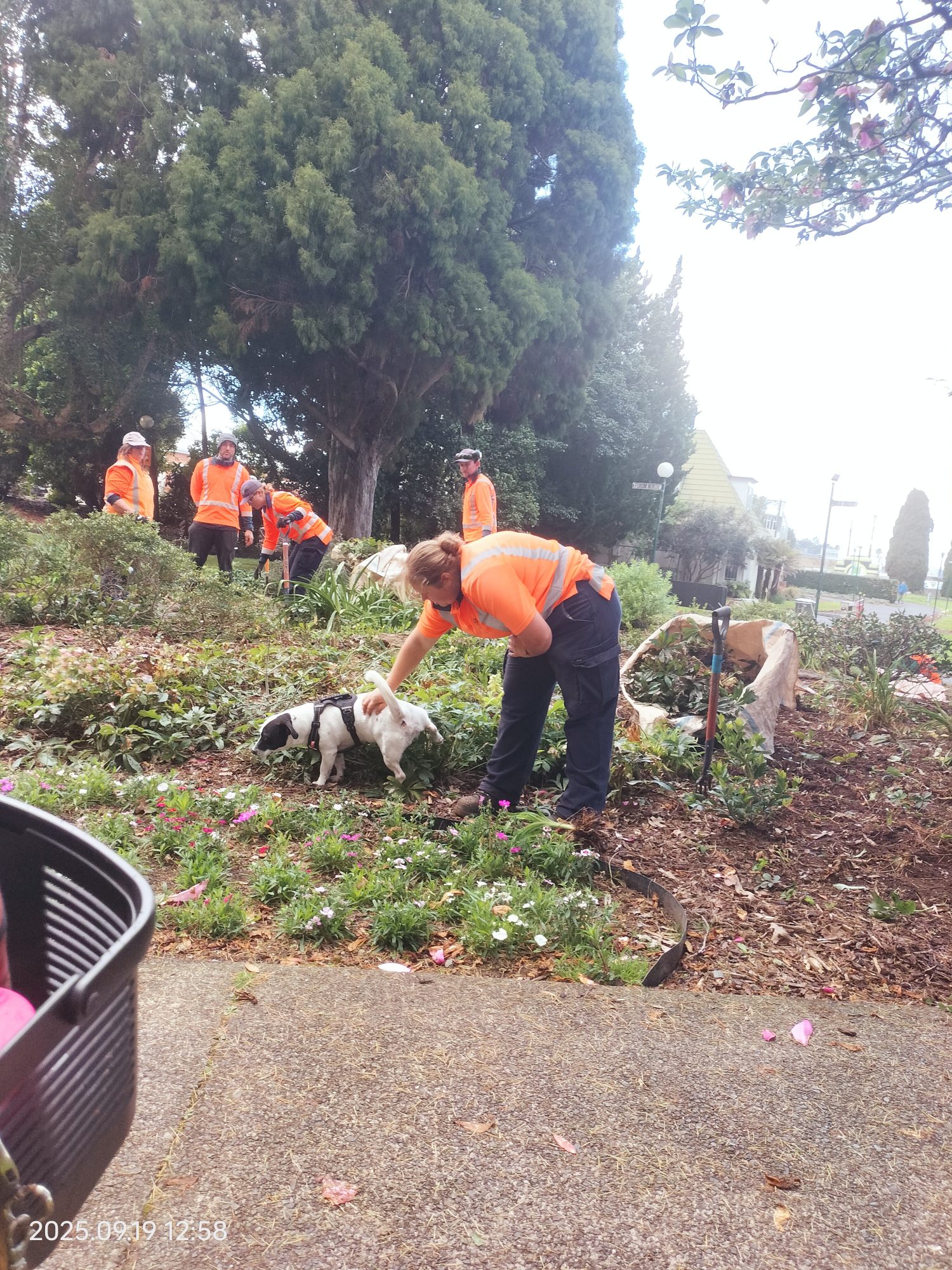
Harvey Dent helping with the planting
Jacqui told me that when they were in Queenstown (October 2025) many people had expressed concern about both the huge number of introduced plants which had become weeds, and the number of pesticides that were being used around that area.
It appears from what we’ve seen so far that Councils are very keen to explore ways in which they can help our butterflies and moths / pollinators / the environment. The MBNZT frequently gets requests for help from residents who want their Council to be more proactive in this regard. So the brief has been expanded to cover:
We have learned so much while we have been sharing information. We’re thrilled that there are people on Council staff who are keen to learn more.
We are supporting a young ecology student at the University of Waikato who is fighting to retain his no-mow area on the kerb (berm) in Hamilton city. Olivier believes it’s important to let nature grow for Aotearoa’s insects. “Plant native, mow less and smarter, and stop spraying. Keep some corners wild” he says.
We’ve also heard from one member who wants to reach out to Council to ensure that the “wild” swan plants at the end of their street are not sprayed or removed – so we are able to liaise with that Council in an official sense.
Take a look at the webpage for “Public Spaces’ on our website.
It was great being involved in tagging this year. This was a new experience for me although the MBNZT has been tagging monarchs from 2007 for thirteen years. I was keen to be involved and help manage the project.
We had two IT professionals who volunteered to set up the program, Travis Nong and Frank Lee, who had never done anything like this before, especially working with Google Maps and JavaScript API (Application Programming Interface). I think we all learned lots of new things with this. The program we’d used ten years ago was no longer available and we had to start from scratch. As a result, we’ve discovered many ways to make improvements to the system for next year before we begin tagging. We need to eliminate as much ‘human error’ as possible, to ensure accuracy in our data being validated.
If this program is to help the monarch butterfly, we have to be as close to 100% accurate as possible, and careful with our data reporting.
In total, 4,362 tagged monarchs were released during the 2025 project, with 257 recorded sightings. Most monarchs stayed close to home, with 129 sightings occurring within 100 metres of their release site. However, 14 individuals made impressive long-distance journeys of over 5km. For an interactive map of all the tagged and sighted monarch butterflies click on this map.
One of the most exciting moments for the team is receiving photos after the system’s initial acknowledgement of a sighting – proof that a tagged monarch has been recovered.
A great example is WAM459, reared and tagged by Copper Hay in Redwood Valley in March, then seen seven months later in Motueka, around 20km away, laying eggs.
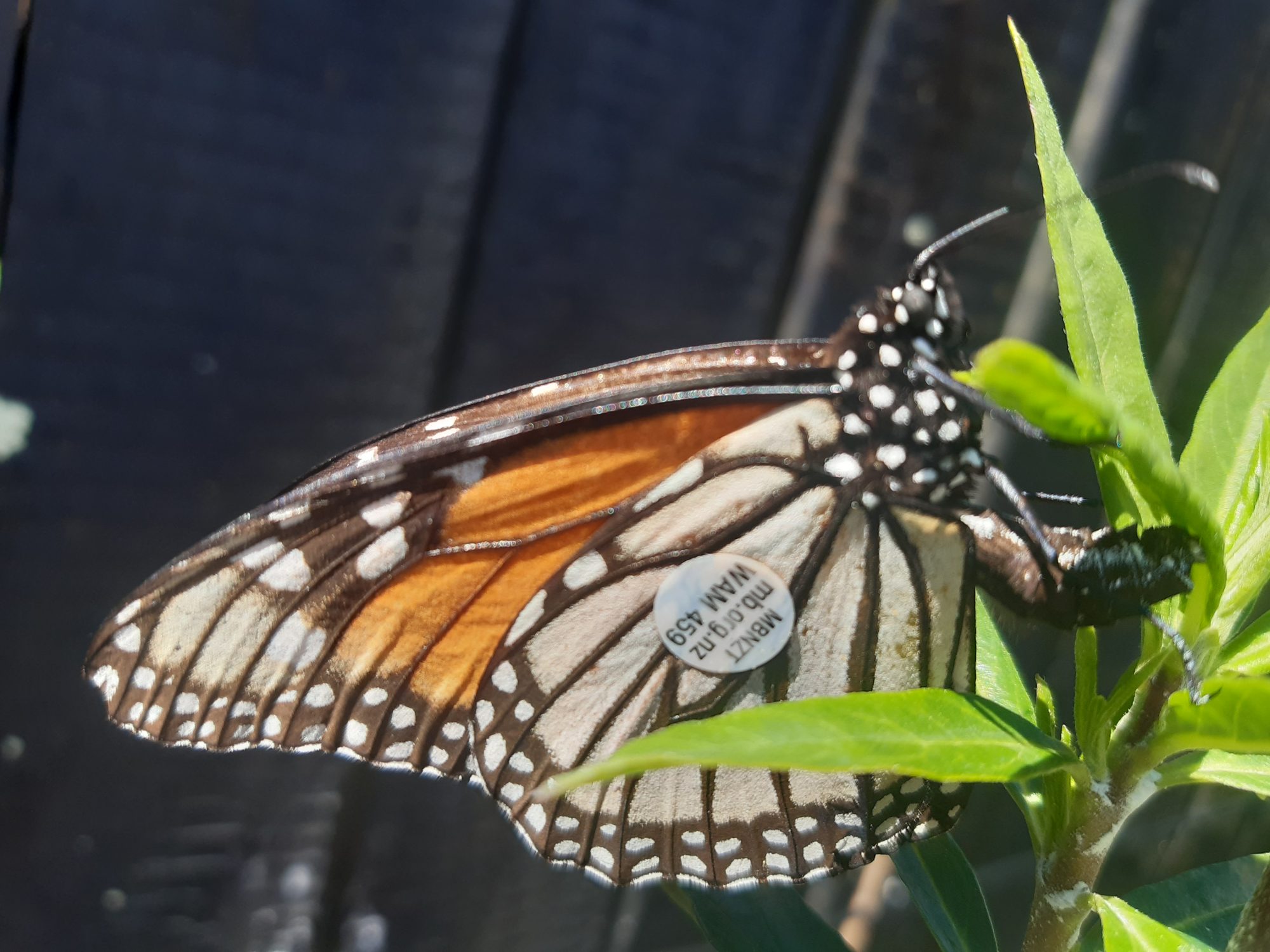
Dr David James, one of the project’s overseeing scientists, noted: “This recovery demonstrates nicely the value of tagging in providing information on monarch longevity as well as movement.” He added that the butterfly was likely an aged female that had spent winter in reproductive dormancy and was now active again – a remarkable insight into monarch life cycles.
The standout traveller? A female monarch that flew from Feilding to Napier – a distance of 140km in just 23 days.
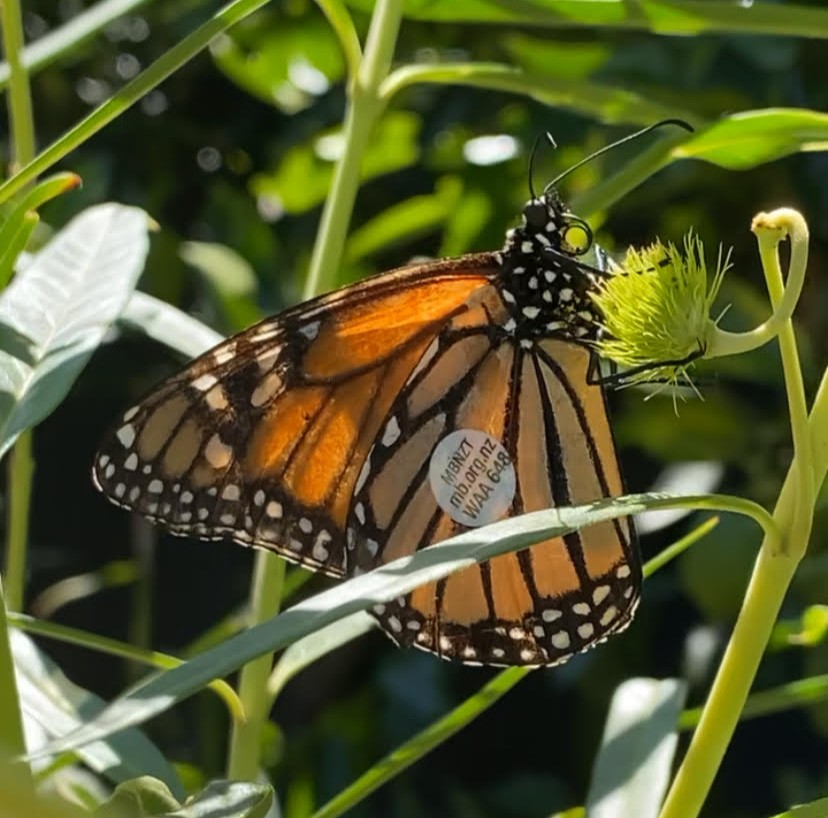
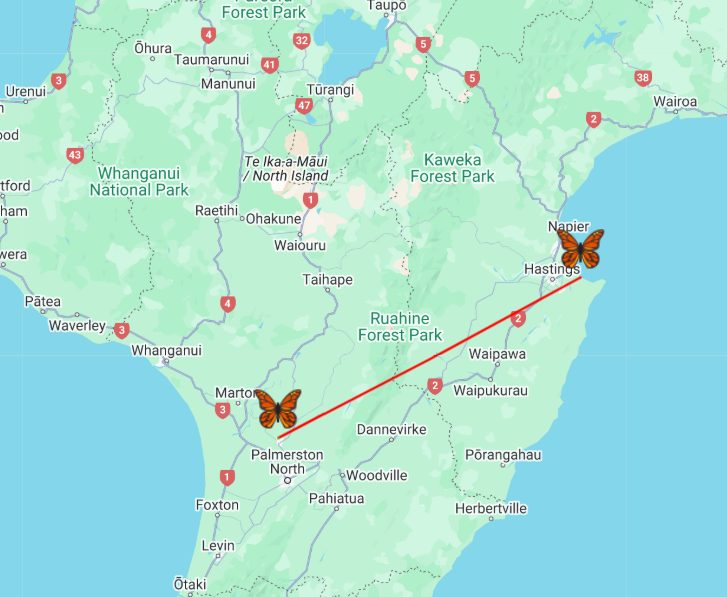
One can’t help but wonder what route she took along the way!
There were also a few mysteries, including one butterfly found deceased well south of its release point. WAE109 was released in Hamilton on 6 April and then found 431kms away in Woodville on 1 May. We are aware of the severe weather in Hamilton over the Easter weekend in April, caused by ex-tropical Cyclone Tam, and wonder if the butterfly was caught up in the wind storm and taken so far off course or did it meet an unfortunate end with a vehicle? These stories remind us just how unpredictable nature can be.
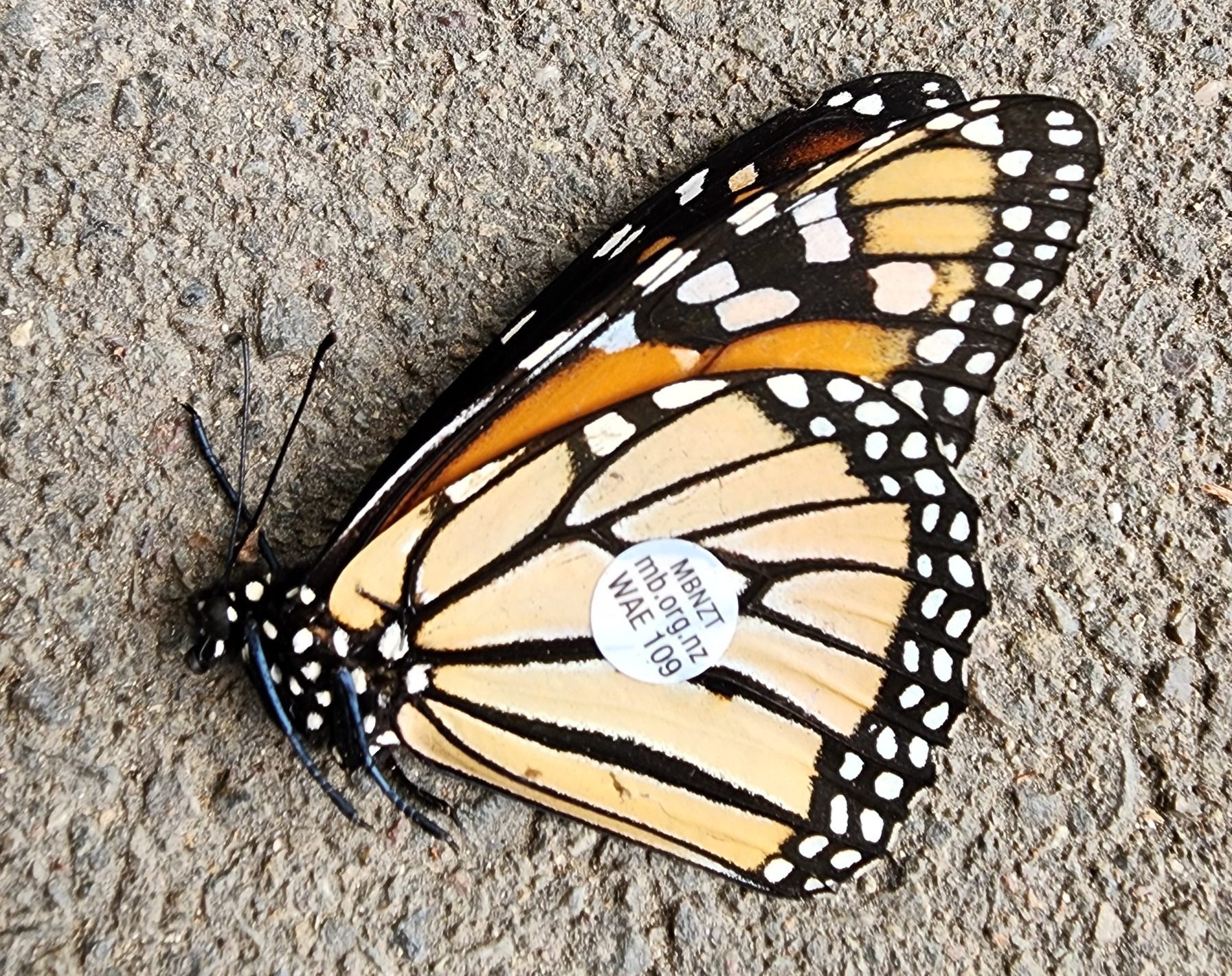
Another interesting finding while summarising the data to date was how most of the male tagged butterflies were located near flowers, and most of the tagged females were found around swan plants.
We still have so much more to learn about these beautiful creatures, hence why accurate data is so vital.
A heartfelt thank you goes out to everyone who participated in the 2025 Tagging Project. Your dedication makes discoveries like these possible.
Thanks to Travis and Frank, our IT professionals.
Big thanks to House of Science for their participation. We look forward to having House of Science members back tagging again in 2026. Two online seminars have already been held with schools encouraging them to plant swan plants and create butterfly habitat, and another to demonstrate tagging will be held in the new school year.
A huge round of thanks to Kiran Thodiyil Kanakambujan who carefully processed and checked that the data collected was valid and useful, and prepared a report for the scientists.
Thanks also to our two overseeing scientists Emeritus Professor Myron Zalucki, at The University of Queensland in Australia, and Dr David James from the University of Washington, for always giving insights and guidance as we go along. It is always appreciated.
We look forward to welcoming you back for an even more refined project in 2026. More information will be in our e-news which goes out weekly, early in 2026.
Map Showing Straight Line Movement
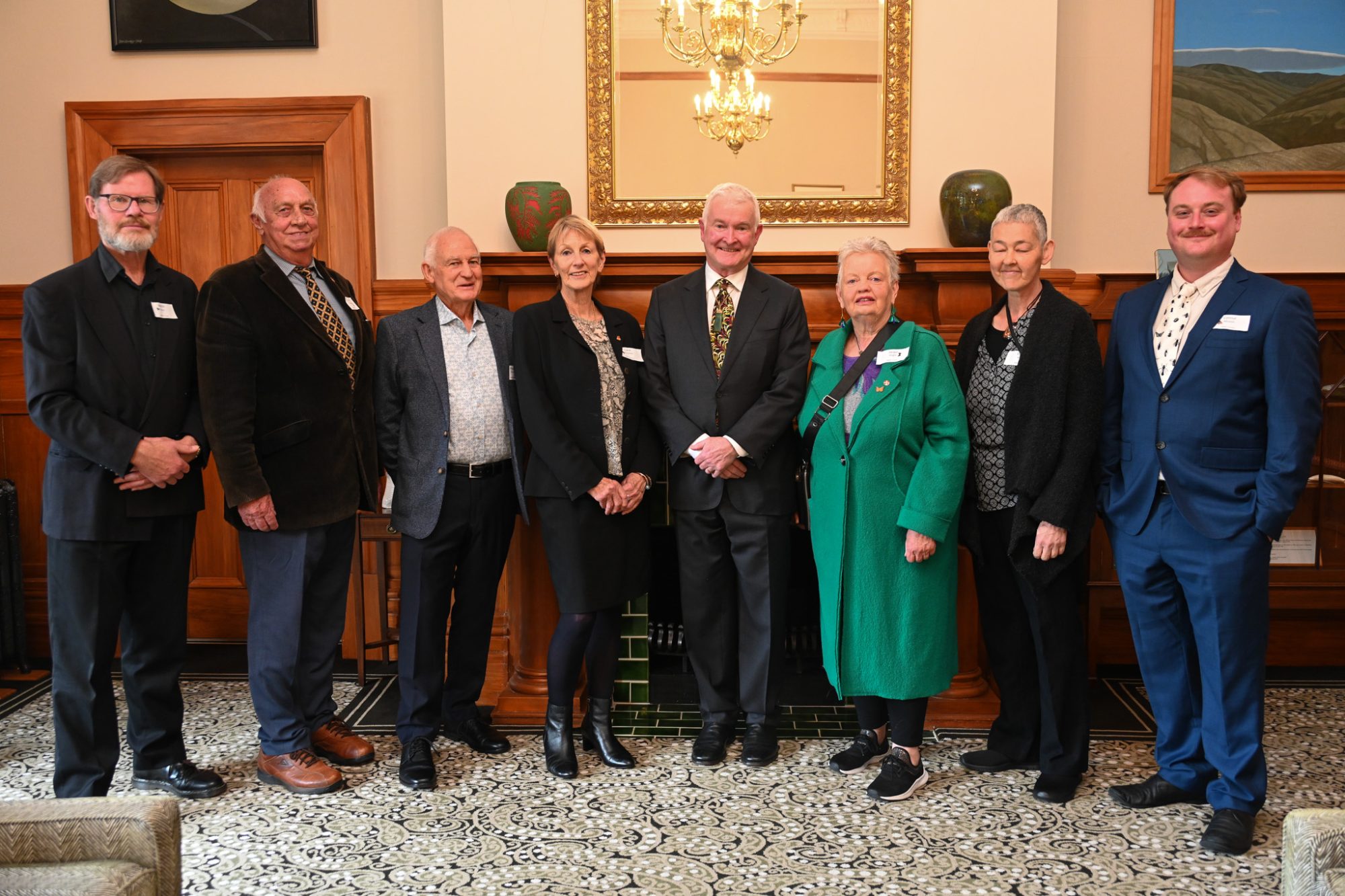
Left to right: Martin Visser, Maurice Mehlhopt, Hugh Smith, Carol Stensness, His Excellency Dr Richard Davies, Jacqui Knight, Devangi Farah and Connal McLean at Government House, Wellington, 20 October 2025
On Monday, 20 October, we were honoured to celebrate a very special occasion at Government House, Wellington — recognising their beautiful gardens as a certified Butterfly-Friendly Habitat, and marking 20 years since the Moths and Butterflies of New Zealand Trust (MBNZT) was founded.
Yes, right in the middle of Wellington — just a stone’s throw from the Beehive — lies a 12-hectare private sanctuary where butterflies and moths are actively encouraged to flourish. It’s a wonderful example of how thoughtful garden care can make space for nature, even in our busiest cities.
“New Zealand’s beautiful butterflies and moths are struggling because of development, pesticide use and introduced wasps,” said Maurice Mehlhopt, Chair of MBNZT. “We are thrilled to be adding Government House to our list of gardens and habitats that foster flowers for nectar and host plants for Lepidoptera.”
His Excellency Dr Richard Davies expressed his delight at the recognition, pleased Government House grounds provide a safe environment for Lepidoptera.H He said that he hoped this recognition by MBNZT will encourage more people to create a similar haven in their own gardens.
For more than 25 years, Bark Ltd has maintained the gardens at Government House with a strong focus on sustainability and biodiversity.
“The gardens are managed to encourage and nurture plant and insect diversity while maintaining the high standard befitting Government House,” said Andrew Jensen, Regional Manager of Bark. “We’re proud that this recognition reinforces our commitment to those values.”
Since it began in 2009, our Butterfly-Friendly Habitat programme has celebrated landowners, schools, community groups, and councils who create and maintain high-quality environments for butterflies and moths. Certified sites display a distinctive plaque, are featured on our website, and inspire others to plant for pollinators.
To qualify, gardens must be well-established, provide shelter and sunshine, include host plants for at least three butterfly or moth species, offer nectar sources year-round, and use natural methods to manage pests.
This year marks two decades of the Moths and Butterflies of New Zealand Trust — twenty years of community engagement, advocacy, and hands-on conservation work. Our vision remains the same: that Aotearoa New Zealand’s ecosystems will always support thriving moth and butterfly populations.
We’re proud to see that vision reflected so beautifully in the grounds of Government House — a reminder that with care, collaboration and love for nature, even our most formal spaces can hum with life.
His Excellency's speech was particularly inspirational, and is reproduced here:
Thank you for formally recognising our beautiful grounds as a butterfly and moth-friendly environment, and I welcome this opportunity to highlight the work of the Trust.
I know our gardeners are thrilled to have their work recognised in this way, and they will have opportunities to spread the message during our garden tours.
In New Zealand we take it for granted that we can so easily get out into nature and connect with the natural world. Most of us are aware of the impact of climate change, but there is not the same level of awareness about biodiversity loss, and in particular the disappearance of insect life.
We are witnessing the devastating impact of human activity on our flora and fauna. Many of the Earth’s species are critically endangered, and some experts suggest up to 25 percent of our species will be lost in the next 25 years.
Over two hundred years ago the great English poet William Blake wrote about our responsibilities to protect the natural world, including the smallest of creatures, when he said:
Kill not the Moth nor Butterfly
For the Last Judgment draweth nigh
His words might seem prescient to us here in 21st century New Zealand where we are seeing the widespread disruption of delicate ecosystems, habitat loss, the effects of pesticide use, and the predations of introduced species.
But there are also reasons for hope, and after all, the butterfly is a symbol of rebirth and hope. We are blessed to have people in our communities, people like you, who are determined to put a halt to the degradation of natural environments – and restore healthy habitats – be they wetlands, forests, streams or rivers.
Last year Dame Cindy and I visited the Chatham Islands, where the community is fully engaged in implementing ambitious programmes of environmental restoration. The islands are home to 25 percent of Aotearoa’s threatened species, and scientists are undertaking research to better understand how to best manage their conservation.
Local nurseries are growing thousands of endemic trees, and landowners, who boast the highest proportion of conservation covenants in New Zealand, are undertaking massive reforestation programmes.
During our visit, we met Lois and Val Croon, whose Admiral Farm Garden is an enchanting haven for a stand of some of those rare trees, as well as the Chatham Islands’ own Admiral butterfly species.
Here on the mainland, while there are gaps in our knowledge about our thousands of moth and butterflies species, what we can be sure of is that their presence in a garden means that they have access to the appropriate food, water and shelter for the different stages in their life cycle.
Their presence indicates that a garden has flourishing insect and microbial life, which in turn contributes to more fertile soil and flourishing vegetation. And at various stages in their life cycle, our moths and butterflies are a welcome food source for other creatures in the food chain, such as birds.
We know that conservation efforts work much better when communities get behind them.
The more people who become involved in such projects, the more we can achieve.
I hope the recognition of Government House grounds will help you promote greater awareness and encourage people to purposefully create the right conditions in their gardens to support Lepidoptera species.
I will certainly be promoting your work during our vice-regal engagements, wherever we are in Aotearoa New Zealand, and I wish you all the very best with your projects in the future.
Some photos from the event are shown below:
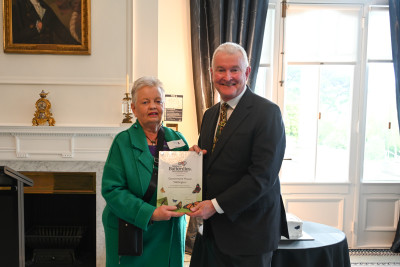
Founding trustee Jacqui Knight presents the plaque to Dr Richard Davies
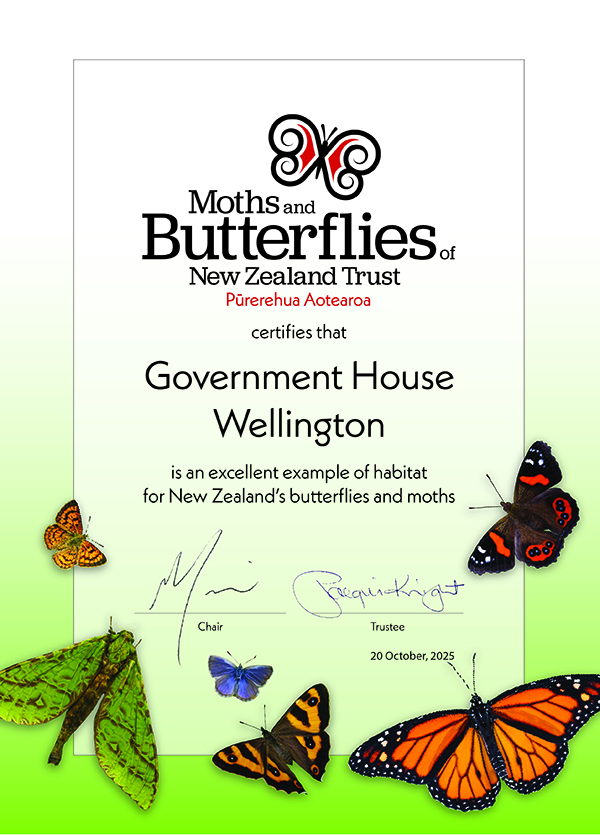
The plaque
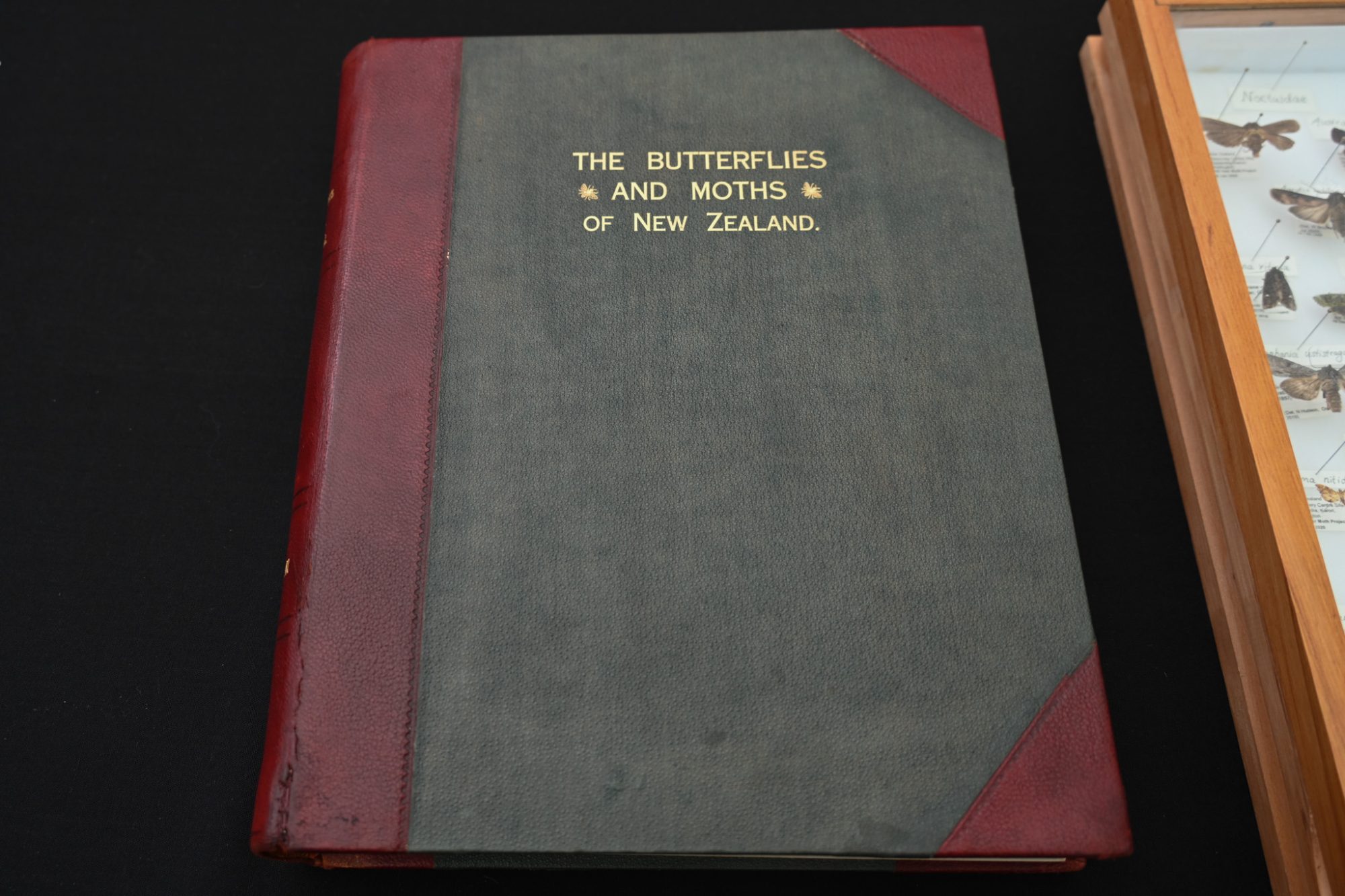
George Hudson's 1928 "The Butterflies and Moths of NZ" presented as a koha
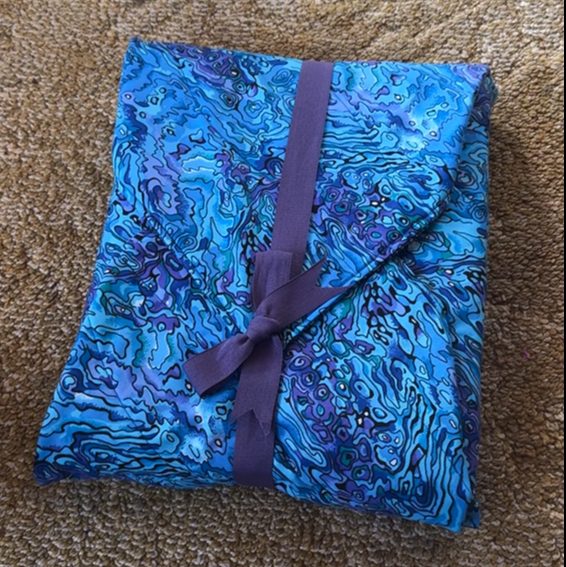
Beautiful presentation case made by Judi Ferguson
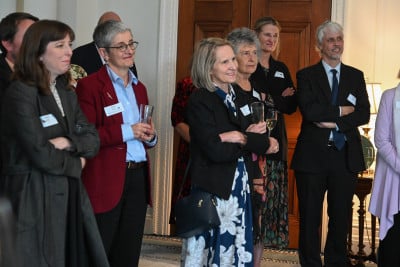
Some of the guests
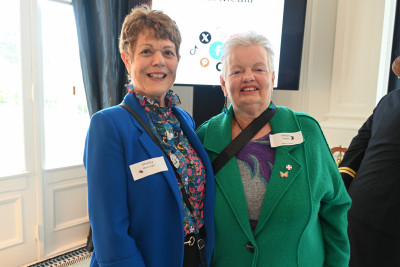
Founding trustees Shelley McGonigle and Jacqui Knight
---
Ehara taku toa i te toa takitahi engari taku toa he toa takitini
My success is not mine alone, but it is the strength of many
Jacqui came and spoke to members of the Coatesville Garden Club recently, and members were asking what to do about the wasps*.
I was happy to share what I do!
It’s clear that the declining population of our butterflies, particularly the monarch, is due to the increased number of wasps, both Vespula species and paper wasps (Polistes). By reducing the number of wasps in our gardens we can give bees and butterflies a chance to survive.
Having a shade house for your potted swan plants is an ideal solution to protect the eggs, and caterpillars, plus installing several wasp catchers around your garden (I have 14) draws the Vespula wasps away from the swan plants to drown in the wasp catcher.
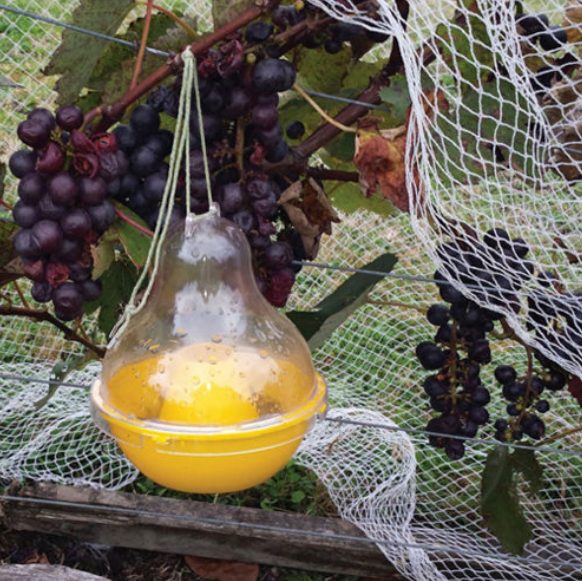
Wasp catchers are cheap to buy at Bunnings, Mitre 10 and The Warehouse (or you can make your own, search the internet for instructions). The stores also have the lure which wasps love.
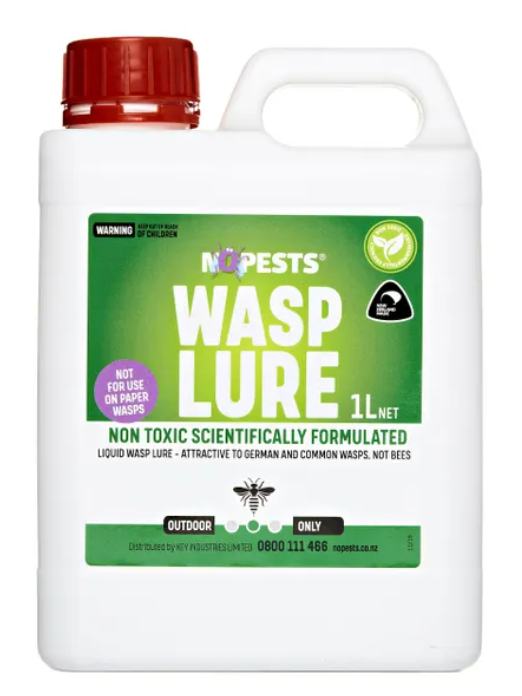
I always add a dessertspoon of cat biscuits (such as Friskies, Smitten or Whiskas) to the lure as wasps are looking for protein.
Hang your wasp traps in a sunny sheltered position on hedges, shrubs, trees. It may take a day or two for the wasps to find it. When the wasps are out in force towards November, December and January you may need to empty the traps almost every day, or I just add another one alongside. Make sure you drop the trap into a small rubbish bag, spray with fly spray to kill any live Wasps before you empty it into a bucket, wash and reset.
Sadly, paper wasps (Polistes spp.) are not interested in the lures: you need to find their nests and remove them.
Happy wasp trapping.
* By wasps, I mean the introduced pest species.
So you've now mastered NZ's approximately 600 macro-moths* and wondering where to go next? The obvious answer, probably, is to venture into studying NZ's much larger and diverse micro-moth fauna. To the beginner this presents a significant challenge as NZ's micro-moths have traditionally been little studied, hence there is a paucity of reference material available to professional and amateur alike. However, trust me the rewards can be well worth the effort.

Stigmella hoheriae, photo Olly Ball
Micro-moths exhibit a fascinating diversity of form and habits as their generally smaller size allows them to exploit a wider range of habitat niches. While many are associated in some way with the higher plants, in NZ a considerable number are found in the most unexpected places such as ferns and mosses, algae and fungi, and on decaying plant or animal materials.
Many, especially when viewed under some form of magnification, are simply exquisite, exhibiting inexplicable marking and adorned in a range of metallic hues – resulting in the obvious question, why? I'll leave the reader to answer that one. Of course, there are also 'little brown jobs' which fit the public's perception of nuisance or pest moths, but these are also essential to the efficient functioning of ecosystems.

Macarostola miniella, photo Olly Ball
As previously mentioned, while studying micro-moths can be a rewarding pastime, to the beginner it can seem quite daunting, not least due to the lack of modern and comprehensive identification field guides. Since Hudson's seminal publications: The Butterflies and Moths of New Zealand (1928, 1939), now inevitably out of date and definitely not a field guide, there has been little published on NZ's approximately 1200 micro-moth fauna. There are however a couple of on-line tools available on iNaturalist, which aim to provide the amateur some assistance with their identification.
When attempting to identify a particular micro-moth it is probably best to start at a higher taxonomic level, i.e. families, as they are defined by a range of characters. It should be noted that it may be impossible to identify on external characteristics alone. Features such as the resting position of the wings, antennae and body of a living adult may be sufficient to identify which family it belongs to. Labial palps, the moths’ mouthparts, are another distinguishing feature and easily observed with a hand lens or a low-powered microscope.
Today many who study moths do not wish to kill or set moths and use the medium of photography to record their observations. The advent of on-line 'citizen science' biodiversity recording platforms such as iNaturalist has certainly transformed the hobby. Images can be uploaded via a freely available app and the observation identified, initially by accepting the iNaturalist provided suggestion, or more frequently and probably more accurately by community experts in the respective field. To be accepted as 'research quality' identification needs to be supported by two or more.
However, for the serious enthusiast who seeks to extend knowledge of NZ's micro-moth fauna, with the potential of discovering a new species, a reference collection is essential. As Dr Robert Hoare states “To gain a knowledge of the smaller moths there is currently little alternative to forming a reference collection and periodically taking specimens into a museum or reference collection to identify them”. It should be noted that a digital image is no substitute for a voucher specimen as you can't dissect a photograph!
Many of the techniques and equipment for studying our macro-fauna are applicable to our smaller micro-moths. However, the effectiveness of a particular method applied to micros may be noticeably different and therefore could impact on where you should direct your efforts for maximum benefit.
Light trapping: Many micro-moth families, e.g. Crambidae, Tortricidae and Pyralidae can be regularly attracted, sometimes in large numbers, to UV and other types of lamp. Other moth families are less inclined to do so: indeed some seem to avoid them altogether and must be sought out by other means. Micro-moths are also more likely to be damaged by larger and more active moths while residing in the trap, adding to the difficulty of their subsequent identification. However, be aware that caddisflies and other potential micro-moth 'impersonators' are likely to comprise a proportion of visitors and can be difficult to separate for the beginner.
By torchlight: Adult micro-moths will seek nectar on similar flower species as the larger moths, hence an examination of using a torch accompanied by a butterfly net should reward the intrepid hunter. Also, when walking through the bush keep your eyes open for micros quietly sat on vegetation and those that take off when accidentally disturbed.
Daylight hunting: A surprising number of micro-moths can be recorded during daylight hours. There are those specialists which are best sought out during the day and those usually active at night that can be 'swept' from their daytime roosting sites. Most micro-moths are not fast flying and do not fly far if disturbed so all that is required to secure the specimen is a good netting technique.
Pheromones: A number of artificial pheromone lures have been developed for monitoring and control of pest species, and in micro-moths for species in the Tortricidae and Pyralidae. However, other 'desirable' species are sometimes attracted.
Early stages: For some moth enthusiasts a real treat is in store if they elect to extend their identification skills in the search for larvae and rearing them on to adulthood. In NZ there are many species that have never been reared and their biology totally unknown. For some species, apart from employing dissection techniques, it's the only reliable method via plant association, for distinguishing a particular species from another.
*Micro-moths make up around 64% of NZ's fauna. While there are about 680 macro-moths the key difference between the two groups lies in their evolutionary history and the families they belong to. Micro-moths mainly represent earlier evolved families.
With the Butterfly Discovery Project there has been substantial progress in examining and obtaining boulder copper material for further study, and some preliminary work towards DNA sequencing. In November I visited probably the two most substantial boulder copper butterfly collections on the planet!
First, I visited Brian Lyford in Queenstown and spent an enjoyable afternoon looking through his magnificent and important personal collection. Brian is an exceptionally dedicated lepidopterist and told me that in recent years he has made a special effort to collect copper butterflies wherever he could find them throughout the South Island. His collection is rich in very recently collected material that should be ideal for DNA extraction and sequencing.
Among the significant known South Island populations, the only ones missing from Brian’s collection are the Milford Sound and Chrystalls Beach populations. He told me that he has been to Chrystalls Beach on more than one occasion and failed to find boulder coppers there, so there is extreme concern about the survival of this population. I was able to borrow 38 selected specimens from throughout the South Island for further study.
An important addition to the specimens seen so far (i.e. those currently in NZAC) was Brian’s material from Tiwai Point, Southland. It was interesting to note the remarkable white wing undersides that dominate in this population; however, there was also a Tiwai female with a strongly patterned underside, indicating that even here there is variation within the population.
I was also able to visit the massive collection of copper butterflies at the Otago Museum, built up by Robin Craw, Brian and Hamish Patrick. They have provided me with samples of the Milford Sounds and Chrystalls Beach populations since that time, so I now have a ‘full set’ of the Patrick & Patrick potential species for further study!

Having obtained Tiwai specimens from Brian Lyford’s collection and impressed by their very white undersides, I went ahead and dissected a male from this population. As before, though, I could find no convincing characters in the male genitalia that would separate this population from others at the species level. Indeed, the genitalia appear extremely like those of specimens from the other end of the boulder copper’s range in the central North Island!
In January I removed a leg from each of 35 specimens of boulder copper (a mix of Brian Lyford’s and NZAC specimens collected in the last 20 years) and have placed these legs in labelled vials in the freezer and databased the corresponding specimens, in preparation for future DNA sequencing.
The binomial nomenclature invented by Linnaeus in the 1750s has been the standard international system for naming Lepidoptera species. Each species, when scientifically described, is assigned a genus name with a capitalised initial letter followed by a lower-case species name, e.g. Aenetus virescens pictured below. Traditionally, most such names are formed from Greek or Latin.

Each genus may comprise of one or more species. Genera are then grouped into families, standard ending '-idae' and these are grouped into super-families with standard ending '-oidea'.
For example, the super-family Noctuoidea includes families like the Noctuidae (owlet moths), which is known for its large number of species. This one is Ipana atronivea or the North Island lichen moth, sometimes referred to as the North Island zebra moth.

However, NZ’s moths tend to have few English, or common, names. For example, all of Britain's 900 or so macro-moths have common names, often describing particular attributes or their history. Micro-moths rarely have recognised English names as there are inconspicuous and therefore far less familiar to the amateur lepidopterist.
As of 2025 the Lepidoptera of NZ belongs to a total of 49 families, ordered traditionally from the most ancient or 'primitive' to the most recently evolved 'advanced' form. Members of a family tend to be a similar shape, size and behaviour. For example, the approximately 165 members of the Noctuidae family are stout moths with thick bodies, wings held across the back when at rest with a forewing length greater than 15 mm and almost exclusively active at night.
Another large family are the Geometrids with nearly 280 species. They have thin bodies and at rest, most, like Hydriomena deltoidata, hold their wings flat in a butterfly shape. They have a rather weak fluttering flight and, as many fly around dusk or dawn and some during the daytime, they could be mistaken for butterflies.

The geometrids include several large sub-families, standard ending '-inae', notably the carpets, pugs and allies. The family name comes from the Greek for ground-measurer, after the odd, looping walk of their caterpillars.
While NZ is poorly represented by some of the larger moth groups which are diverse overseas, it is blessed especially in the range and diversity of the smaller, micro-moths. For example, the litter-feeding Oecophoridae with more than 140 species, and the largely moss-feeding Scoparinae with over 130. Also, the very small, diverse tineids, many forest dwelling with 70 species, see examples below.

Trachypepla euryleucota

Eudonia submarginalis

Opogona omoscopa
Moths and butterflies are insects which together form the order called Lepidoptera, meaning 'scaly-winged'. The patterns and colours of their wings are formed by thousands of tiny scales, overlapping like tiles on a roof. These scales have been magnified 300 times.

At the last count there are around 1,880 named species of Lepidoptera found in NZ, including around 30 butterflies, while the UK with a similar land area includes over 2,500 species of moth though fewer than 70 butterflies. An important difference between the two regions is that in NZ over 85% are endemic, occurring nowhere else. Also, there are possibly over 200 species in NZ still to be named.
There are no simple rules for telling moths from butterflies and most of the differences are minor. Moths and butterflies share the same basic biology and have far more similarities than differences. According to Robert Hoare, entomologist at Manaaki Whenua - Landcare Research “butterflies are simply a group of specialised, day-flying Lepidoptera”, i.e. modified moths since they evolved from moth ancestors. However, in general the swollen tips of butterfly antennae distinguish them from day-flying moths. Also, commonly we associate moths with night flying.
As there are so many more species of moths than butterflies, experts split them into two groups, the larger or macro-moths and the smaller, or micro-moths.
There are around 680 macro-moths in NZ (900 in Great Britain), whilst micro-moths make up around 64% of NZ's fauna. Many micro-moths are very small indeed with a forewing length less than 4 mm, although confusingly a few of them are larger than the smallest macro-moths!
Moths vary greatly in appearance as well as size. For example, NZ's largest and best known puriri moth comes in a range of colours, from the typical pale green through yellow, blue to salmon pink. They also come in a range of sizes with small males having a forewing length of less than 27 mm while large females are up to 70 mm.

Other shapes are characteristic of different moth families, i.e. plume moths having delicate feathery wings. Colours and patterns also vary, some very bright and bold while others have wonderful camouflage.

Moths are very diverse in their ecology too, and can be found in surprising habitats, not just native forests, gardens, and farmland but also wetlands, coastlines and even mountain tops! You can also see moths at any time of the year, including mid-winter, although summer months are generally more productive.
Be kept posted about our special offers, events and news weekly. Better yet, become a financial member of the MBNZT