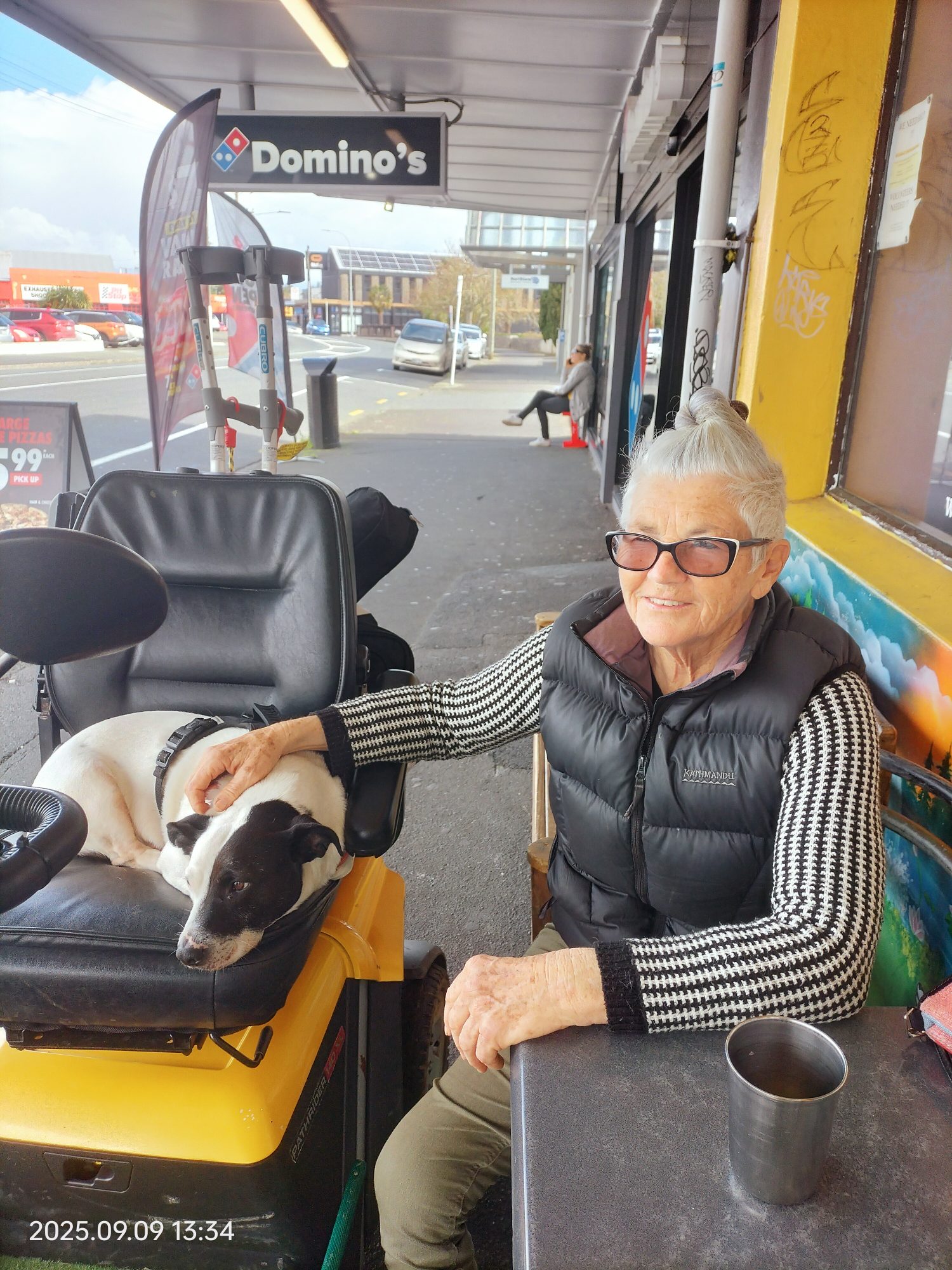
Coffee break for Jeannette and Harvey Dent
Since November 2023 my dog, Harvey Dent, and I are out and about on my mobility scooter in the beautiful Whāngarei parks every day, so I have now seen the annual cycle of plantings of the flower beds here.
I told Jacqui I’d like to do more to help our pollinators thrive, because I believe local government could be encouraged to focus on more nectar-producing flowering plants in their public places. So I got together with Lynda Emery and Jacqui and we’ve been working on a project which has morphed from “Help our Pollinators Thrive” to the Public Places project.
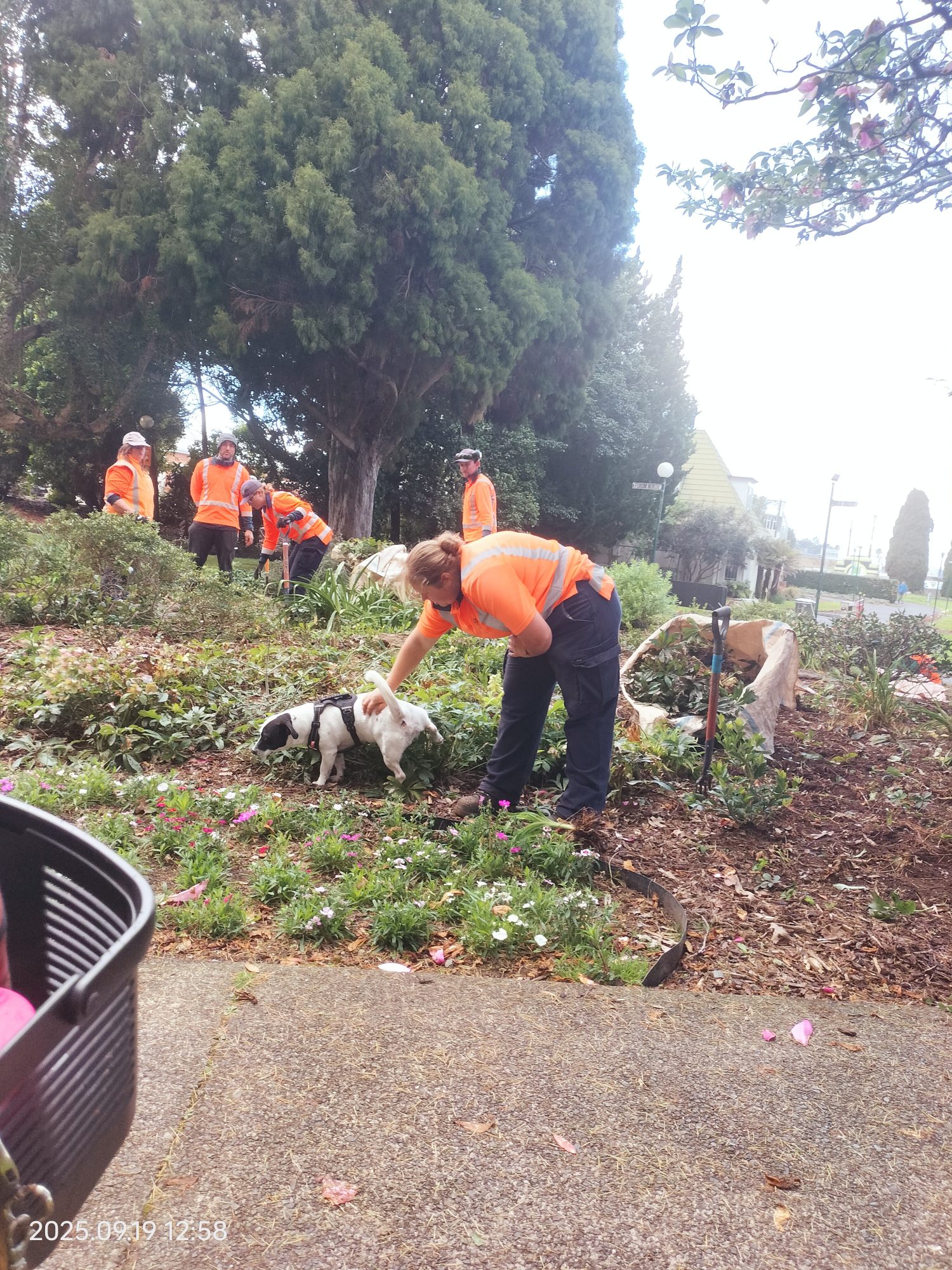
Harvey Dent helping with the planting
Jacqui told me that when they were in Queenstown (October 2025) many people had expressed concern about both the huge number of introduced plants which had become weeds, and the number of pesticides that were being used around that area.
It appears from what we’ve seen so far that Councils are very keen to explore ways in which they can help our butterflies and moths / pollinators / the environment. The MBNZT frequently gets requests for help from residents who want their Council to be more proactive in this regard. So the brief has been expanded to cover:
- Planting more nectar plants
- Encouraging no-mow and low-mow areas to benefit pollinators
- Reduction of pest species, in particular introduced wasps
- Use (or reduction in the use of) pesticides
We have learned so much while we have been sharing information. We’re thrilled that there are people on Council staff who are keen to learn more.
We are supporting a young ecology student at the University of Waikato who is fighting to retain his no-mow area on the kerb (berm) in Hamilton city. Olivier believes it’s important to let nature grow for Aotearoa’s insects. “Plant native, mow less and smarter, and stop spraying. Keep some corners wild” he says.
We’ve also heard from one member who wants to reach out to Council to ensure that the “wild” swan plants at the end of their street are not sprayed or removed – so we are able to liaise with that Council in an official sense.
Take a look at the webpage for “Public Spaces’ on our website.