The Spring school holidays begin next week and we have some treats for you.
We work with a team of AUT students who are in their final year of a degree in PR/communications. As part of their studies and final exam Antonia, Kubra, Madison, Skylar, Tia and Yianna are working on a PR project for a charity. They are promoting our #sprayfreeleavesplease and #ApprovedByButterflies campaign.
As part of this they have designed two colour-ins for children, one is Billy the butterfly and the other is Bailey. Click on either 'Billy' or 'Bailey' below to download one for the kids to complete and be in to win. Please add a mail address when they've finished, so we can then mail them their prize.
Gus Evans is now retired but for many years ran his own nursery at Waikanae on the Kapiti Coast, where he grew swan plants. Read about the adventures he had:

Swan plants? We grew them for over 40 years. I always said swan plants are like alcohol and cigarettes … I know you will be back for more!
We grew them in a totally covered house to avoid monarch attacks. But apart from monarchs, pretty much the only other thing that ever bothered them was the little orange aphid, Aphidius nerii.
Our top tip to people was, at the end of the season, to plant 3-4 close together and make a total shade cloth cover over them to allow the plants to grow into something quite substantial and be able to sustain the first invasion of caterpillars in the new season. The cover needs to be large enough to not touch the leaves on the plants as butterflies could lay on them.
An old guy who lives not far from us had an old swan plant that had a real stem on the bottom of it – I would say about six or seven years old. Maybe you’d call it a ‘trunk’. Every year that could sustain 600 caterpillars at any one time. It was massive, and every year totally covered.
We built up a real clientele over many years. Garden centres and the public trusted us implicitly that our plants had never been sprayed. For that reason, we had huge pre-orders year after year. We grew the same amount every year, about 6,000 in 1.5L pots. We would plant three per pot, so customers got their money’s worth and were satisfied.
We would give away many to schools and kindergartens (until they were notified it was poisonous), and people we knew who loved them but couldn’t afford it for their kids. How many kids have you seen eat swan plant leaves? Yet in our laundry sink cupboard we have far more potent dangers.
Over the years we have shared so many monarch stories. People make such a hobby of raising monarch caterpillars. One Christmas Day I got a call from a lady who said her monarchs had run out of feed, and could I open up, and get her some urgently? We did!
The funniest story is this: One year a large garden centre asked us for 600 plants with the proviso that each plant would have a caterpillar. No problem, I thought. I put them all outside about a fortnight before delivery, and sure enough heaps of caterpillars!
So, we dutifully set about putting a caterpillar on each plant. However, on the journey into Wellington they decided to migrate all over our van. The caterpillars were on my neck, crawling up the windows, on the roof … everywhere. Amazing! When I arrived, I said to the boss lady, I have good news and bad new.! The good news is there are all your plants but … there are all the caterpillars. You are going to need to grab them.
It was hilarious, all their staff coming out and re-introducing all the caterpillars to the plants.
We have met so many interesting people over the years sharing the love for monarchs. One lady would buy hundreds off me every year but insisted on picking her own plants. For maybe 100 plants she would spend at least an hour. She used to crush the orange aphids in her fingers. We used to drown them by immersing the plants in a deep bath, eliminating the use of sprays, which was the golden NO NO! She used to discuss with me breeding first and second-generation monarchs.
Another funny story was when we first got into swan plants, the first time we potted them up was outside. We went for lunch and when we came back, they had been invaded. Eggs everywhere. We spent many weeks picking off caterpillars, as the damage they caused with their voracious appetite made the plants unsaleable. Lesson learnt: only pot inside in future.
Pretty much it is very expensive to buy small plants every season as within two days the plants are stripped bare and we have hungry caterpillars. Some people even cried that the caterpillars were hungry, such is the emotional attachment people have to monarchs.
Try hard to grow some big plants to sustain the attack of the monarch butterflies. If you have been buying small plants each year, check out the tips on the website here and see if you can modify your garden to accommodate larger swan plants.
Here’s Gus secret to growing his plants:
We always sowed seed. We always used Daltons Seed Sowing Mix, lightly covering the seed. We would start sowing our first batch in July, and every month afterwards, with the final sowing in November. That way we had continuity and guaranteed ongoing supply.
We would put the seed trays on bottom heat for germination. When they had germinated, we would prick these out in about three weeks into 5 cm tubes, and then finish them off in 1.5 litre pots. It was essential to have good light after germination so as not to draw the plants and make them spindly.
After they were potted, they would be for sale at about 800 mm high in seven weeks.
We never fertilised again as it was a quick crop to produce, but it is essential to use a top-quality potting mix with all the good fertilisers in it, such as Daltons Potting Mix. The cheapest mix is not necessarily the best.
Sometimes yellowing may occur. For us this would be caused by overwatering as there was definitely no nitrogen deficiency. Perhaps if established plants are turning yellow, they may need some good slow release fertiliser around the drip line.
We would feed the plants twice a year if outside, and as a rule of thumb feed them as they are going to sleep (say late March) and again as they are waking up in September.
Thanks, Gus!
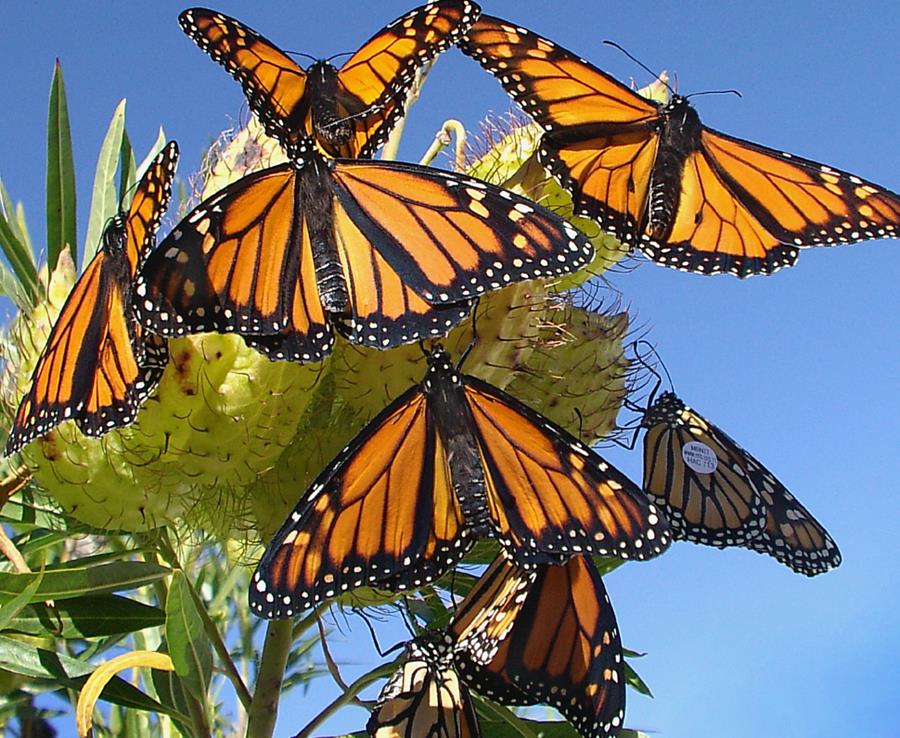
It’s critical everyone understands that when you have hungry caterpillars later in the season you MUST NOT depend on buying plants for food. You need to plant well in advance. Get plants well established before those first butterflies return. Buy or grow twice as many as you’ll think you need – you can keep some out of reach of the monarchs. Keep successive plants growing and flourishing.
I know of two people in Dunedin that have plants lasting for more than one year. Their plants are growing in a warm, sheltered part of the garden. So possibly, in cooler areas, you could get plants going this year which you can keep for later years.
If you are buying seed, now is the time to buy a packet or two and get the seedlings established in pots indoors.

There are more useful hints on the webpage designed specially for the purpose of helping our monarchs: click on the link. And also watch out for 'Top Tips' like these, in our weekly e-news.


Everyone who becomes a financial member of the MBNZT (while stocks last) receives a FREE copy of George Gibbs' book about the Monarch Butterfly in New Zealand. It's so helpful learning about monarchs.
An Exquisite Legacy was mentioned in despatches recently and we’ve since been asked for copies in our shop. So here’s your opportunity. This is the illustrated biography of G V Hudson (1867-1946) one of this country’s greatest pioneer naturalists and artists. The illustrations of NZ insects are remarkable – a national treasure. Note: we have a limited number of copies so this is not on our website. Only $55 plus $10 P&P. Order now by emailing your name, address and payment details and paying into the MBNZT bank account with Kiwibank 38-9009-0654693-00 to .

During winter, frosts occur on clear, still nights. As the air outdoors gets closer to freezing (0o C), the surface temperature of your plants can go below freezing causing ice crystals to form, just as dew forms on warm nights. Of course, temperatures vary just above ground level so frost can also form even when the thermometer isn’t at 0o C.
Wherever your live in NZ your plant might continue to grow throughout the winter, even if it's slower. If the plant is in a pot, make sure it’s not rootbound. If there are roots coming out the bottom it is time to find a larger pot, and you can feed the plant well at the same time.
If you have a swan plant in your garden that you want to protect for next season, and during previous winters you’ve experienced frosts, snow and freezing conditions, you might find these tips helpful.
Cut off any old growth, dead stems, discoloured leaves. When you cut the stem, cut on an angle away from the ground so that any moisture is more likely to drain away, rather than sit on the open wound. Also make the cut just above a node, where the buds are located.

This area has great cellular activity and growth. New buds will form in the spring and develop into stems with more leaves. Each cut is going to provide twice the amount of growth. You should be able to feed twice as many caterpillars!
Almost any type of covering will work, but old blankets, sheets, and even burlap sacks are best. Drape the covering loosely and use stakes, ties, rocks, or bricks to keep it in place. Plants growing under the eaves of your house and on the northern side (usually more sheltered and getting more sun) already have the advantage. You’ll have to put some thought into placing the covering … you don’t want to squash your plant, but the pruning will have helped eliminate the weaker stems. Spring-loaded clothes pegs are really handy. Put the covers over in the evening and that will keep in any heat from the day, and remove the covers when the sun comes out the next morning. You don’t want your plant to suffocate.
Mulch helps to lock in moisture and, during cold weather, holds in heat. Try to keep it thick, about 5-10 cm is ideal. You can use loosely-piled leaves, straw, pine needles, bark or shredded paper.
If you have a good warning system that a frost is on the way, water the plants well before frosty weather arrives. Wet soil holds more heat than dry soil – but don’t saturate your plants while temperatures are low as this could cause the soil to swell when it freezes.
If you see seedlings in your garden, you could pot these up and put them in a cold frame. Cold frames can easily be made from old windows and bricks – basically they are four walls with a glass ‘ceiling’. I have seen a cold frame made with old hay bales which are great insulation. A great opportunity to recycle old materials.
We hope these tips are helpful to those of you living in colder climes. Some of our members in Dunedin manage to overwinter their plants … so perhaps you can do so too (even if people say you can’t).
Imagine biking from Mexico to Canada and back again, with no support crew... just millions of monarchs to guide and encourage you.

Sara Dykman wanted to raise awareness of the endangered monarch migration by following them (she was on a bike) from the overwintering habitats on their round trip.
She then wrote her book. As Dr. Jane Goodall, DBE said, her 'extraordinary story seamlessly weaves together science, a real love of nature and the adventure and hazards of biking with butterflies from Mexico to Canada and back.'

Sara is multi-talented! She has founded beyondabook.org to foster lifelong learners, boundary pushers, explorers, and stewards. She is also an amphibian researcher and works as an outdoor educator, guiding young people into nature so they can "delight in its complicated brilliance".
In the Northern Hemisphere, in the fall (Autumn) monarchs to the east of the Rockies begin to fly south. Some of them - or their progeny - make it all the way to overwintering sites in Mexico.

Sara was in Mexico at the time of their arrival... December - January - February. Towards the end of February and into March the monarchs leave and begin flying north again. And so did Sara.

MBNZT members were lucky to have her present, viz Zoom, to our members and followers after our AGM in March 2022. We laughed to think of her falling off her bike when she saw milkweed.

Her courage has to be admired when she found it hard to find accommodation...

There was laughter when we heard about the amazing gift of an ice-cream she received in Mexico!

You can also enjoy what she had to say! Listen in HERE.
We love hearing from our members. Marion Leahy wrote to us recently about raising monarchs. This is what she shared with us:
I began studying the monarch butterfly life cycle long before the advent of the Trust. Over the years I have observed:

This begins white and changes to grey as it develops. When the little black spot, the head, appears it is ready to hatch. It will eat some of the egg case for the first meal and possibly a small ring of the soft layer on the leaf before going up to the new leaves.

The caterpillar will outgrow its skin and to do so they often move to a dry stick or down the plant stem where they anchor themselves in order to crawl out of their old skin. They will stay in this position for some time, secured by silk. This prevents them being blown or washed off. At this stage they should not be moved.
They grow steadily as they eat, and need to change to another skin four times. The larger caterpillars change quicker. When they are fully grown and ready to change into a chrysalis (fifth instar) they will be large, fat and so firm that a gentle hold does not impress upon the body.
If the leaves should run out caterpillars will eat the stems of young plants which will dry out the plant and it will die. A tight clip can save the plant. Meanwhile they will also eat the flowers and seed pods.
Pumpkin and cucumber should never be fed to caterpillars. Alternative foods such as cucurbits will often lead to deformed butterflies - but also, we are not sure what it is doing to the parts we cannot see, such as reproduction, migration, diet of the next generation.
When food has run out I have found that left alone caterpillars will go to hang by themselves, even half and quarter-sized ones. These will become perfectly formed miniature males and females.

When the caterpillar is ready to hang it will choose a spot and it will extend and wave its body around. This is so to ensure that there is enough room for the wings to expand when it leaves its chrysalis. It will create the white knob that it will hang from. When this is ready it will turn around and attach its rear end onto the knob.
The 'J' will hang while the innards become semi-liquid but every drop is a specific part of the butterfly. As the time passes, the yellow rings take on a greenish tinge. When this is complete the 'J' will straighten out. Shortly after, it will ‘pulse’ from the top to split the skin over the head. If the caterpillar skin divides further up the 'J', or the change goes too slowly, the skin will dry out and not move. It is very quick to concertina the old caterpillar skin upwards, then to wriggle and shake it off. The chrysalis will then tighten up to the lovely shape with the gold dots we know.

Starting as a misshapen light green sac, they quickly tighten up. At this stage the new case is very soft and is easily damaged so should not be touched. When it is hardened, a fallen chrysalis can be re-hung by its webbing, or if it has no webbing it can still hook onto a piece of re-used webbing, but you have one chance to do it as the hooks are very delicate. A chrysalis lying down will still eclose as long as it is cradled against something it can climb up, as it has to be able to hang the wings freely.
The shade of green gradually darkens and as it does the formation of the wings can be seen. When the chrysalis goes dark it is first a greyish black but it goes a clear, shiny black when it is ready to eclose. This is because the butterfly separates from the transparent cuticle. Again, the cuticle divides at the face of the butterfly, and the legs and proboscis appear. When the feet have hooked onto the fine ring around the old case the body is flipped out backwards and the wings freed. The body is full of fluid, meconium, which the butterfly uses to pump into the wings to extend them fully. They will stay hanging until all wings are down, then the fluid is expelled from the body. They will not move until the wings are dry and stiff, but then they will wish to fly soon after.
Should a butterfly fall from the chrysalis it must be lifted immediately for it to survive. It should be lifted by holding your finger under its feet and moving it onto somewhere safe. Should it not hold on and you persevere it will frantically try to get up but not stop moving. The fact that the wing stage has been interrupted I have found that they end up with the equivalent of brain damage. Although the butterfly may end up looking okay, it does not fly properly but flops around the ground.

Have you noticed that the butterflies only use four of their six legs as legs? The front two legs aren’t used for standing – they are vestigial and now used for signalling or communication, and testing the quality of the leaves.
For years a little boy, now a grown ship master, used to come to my place visiting with his grandfather. His first question was always 'Are there any caterpillars in their sleeping bags?' The little skin on the floor was likened then to the pyjamas left on the floor, just as children do.
I know you will know most of this from your own observations, but I thought it would be a help to others if the sequences were noted more clearly, as there is a lot of mis-information around.
Thank you for the glossary on the website.
Regards, Marion.
P.S. There is an excellent site for information, that of the Monarch Joint Venture.
Here's the link to our 2025 report on the introduced pests wasps:
There are over 2,000 different species of wasp in NZ and most of them are solitary wasps, i.e. they do not make nests. The five species that are a nuisance to us humans are all introduced and give the others a bad name.
If you are encouraging butterflies then you will be well aware of the main predatory wasps, the social wasps. Three of these species make paper-like nests hence the name 'paper wasp'.

At the beginning of the summer, social wasps are intent on nest-building, then laying eggs. When the eggs hatch the adults search for protein to feed their young..
Bingo! Caterpillars are a great source of protein. For several months social wasps will steal your eggs and caterpillars of all stages, even pupae. By the end of the summer the juvenile wasps will be adults, and then the wasps will all be seeking out nectar for energy (no longer protein for building better bodies).

Nest of Asian (paper) wasp, thanks Alison Meier
Paper wasps (Polistes spp.) build nests from chewed up wood material, hence their name. When flying, a paper wasp's long legs hang down below its body.
Nests of the Vespula species are usually found in caves, trees and underground.
These wasps affect beekeeping operations as well as our native flora and fauna, and their stings can genuinely be a health risk. Be vigilant when outdoors around your property, looking for nests. Often they are in trees, bushes, or on buildings such as fences and the outdoor faces of homes and garages.
Tell the neighbours, pointing out what a pest these wasps are. Social wasps usually only forage within 200-300 metres of their nest. If you've located a nest, go out at dusk when the wasps are inactive and spray it or remove it with a plastic bag, tieing it off and putting it straight into the freezer. After 24 hours the wasps will be dead and you can put it into your rubbish.
"Wasp traps" may not be effective. So far we haven't found one that works (traps or baits).
Caterpillar castles work a treat!
Net curtains no longer useful for the house can be reused in the garden making it harder for wasps to "get into" your plants to attack the caterpillars. A mosquito net over a frame can also be used. Throw the net over your swan plant in the garden. Monarch butterflies have been known to lay eggs on the outside of the net and the caterpillars that emerge climb through the mesh onto the plant.
For monarchs, grow swan plants now for next year and encourage them to bush out by pinching out the new growth. Not only does it mean the plants provide more shelter and protection but also more food for more caterpillars. Plant plants close to bushes and shrubs that offer nectar (such as Hebes, or annuals like zinnias and cosmos) to give more shelter as well.
Please feel free to add more tips in the comments below!

Have you run out of milkweed (swan plant) and been tempted to feed them an alternative? Please don't do it.
Monarchs are milkweed butterflies, and their host plant is milkweed.
Most butterfly species are 'linked' to a single plant species, which is the food source for their larval form (caterpillar). These plants are referred to as host plants.
When monarch caterpillars eat milkweed they absorb a variety of chemical compounds that make monarch caterpillars poisonous to potential predators. Milkweeds contain a cardiac poison (cardiac glycoside) that is poisonous to most vertebrates but does not harm monarch caterpillars. Various milkweeds have higher levels of these toxins than others.
In fact, cardiac glycosides are used in human medicine for treating heart failure and certain types of irregular heartbeats.
Have you watched a monarch laying eggs on your swan plant. Firstly, she tests the leaf for its suitability with her two forelegs called brushfeet. If it doesn't have the right balance of nutrients she moves on to another plant.
When we introduce hungry caterpillars to another food such as pumpkin or any other species in the cucurbit or gourd family, the caterpillars may eat it but they are not ingesting the food that they need. It's a bit like eating junk food ... our healthiest athletes don't eat junk food.
Asclepias and Gomphocarpus are a genus commonly known as milkweeds. They are in the Apocynaceae family. Pumpkins or squash are an entirely different genus (Cucurbita). Another plant which has been trialled as a host plant for monarchs in the past is Araujia sericifera, a fine which is a pest plant in NZ. It is closer to the milkweed genus, but not close enough to be a successful host plant. As well, A. sericifera has the common name of 'cruel plant' because it traps butterflies and moths by the proboscis, and they will be unable to free themselves.
Many of us have tried using alternative foods in the past. Monarchs fail to pupate or die in the latter larval stages. Butterflies emerge as weak specimens, with crippled wings, or unable to fly. And as well as those visible symptoms, we do not know what long-term damage we are doing to the species as a whole.
This makes life difficult, doesn't it. You have too many caterpillars and not enough swan plant. There are some excellent tips on how to best utilise the swan plants you do have on our website here.
As well as those tips, NOW (when you are reading this) is the time to plan for swan plants for next year. Plant them now and keep them covered so you'll be able to see more magnificent monarchs next year.

Aphids are very much a part of the complex natural jigsaw that is your garden. We need to understand the part they play in a 'butterfly habitat'.
In an earlier blog post I stressed how everything in Nature is connected. When you have swan plants (or milkweed), oleander aphids (Aphis nerii) will soon find your plants. Aphids, bright yellow, pear-shaped insects, only a few mm long, with their soft bodies, will suck the juices from your plants, causing them to wither and fail. They particularly like the tender, young, new shoots or plant tips of your plants.
Just when you're imagining how many monarch caterpillars will be able to dine on your plants, the aphids arrive and start to play havoc with your 'crop'. By piercing the cell wall of leaves and stems to suck the sap they weaken the plant, leaving a wound that can allow disease to get in.
Normally, with a healthy swan plant, the aphids will do no more damage than when we graze our knee. A healthy plant can withstand aphids, but weaker plants go downhill quickly.
Because you want your swan plants to be free of chemicals you cannot reach for a commercial product. You have to help Nature using natural means.
When you first see an aphid or two observe and do your research. Don't reach out for a pesticide, just observe, read up about aphids, be vigilant and patient.
Are your plants well-watered but not standing in wet ground? Run your finger over the soil – if it comes away dusty the plant needs watering. (Muddy? Probably not.) Are they well fertilised, mulched? Do they have plenty of room? If they're in a pot, check that the roots aren't bursting out the bottom. If you see a tangle of tiny roots the plants should be in a larger pot.
Don't grow all your swan plants in the same place, year after year. Each plant species removes certain nutrients from the soil. By growing different plants on the same piece of land it improves soil health, optimises nutrients in the soil and combats pest and weed pressure. This will lead to healthier swan plants, more resistant to disease. (This is called 'crop rotation'.)

While you're waiting patiently to see what is going on, there are some actions you can take without interfering too much. High-pressure hosing the aphids will remove them from the plants. So will squishing them with your fingers – wear gloves if you don't want your fingers stained orange. Or you can also cut the piece of plant that is infected with aphids and put it in a plastic bag and straight into your waste system (or you could wash the stem and leaves you've cut off, and feed it to monarch caterpillars.) But remember, if you see signs of other life with your aphids, you need to stop immediately and let Nature take its course.
Encourage beneficial insects – the kind that will get rid of the 'bad guys'. Some of these work from the outside (predators) while others work from within (parasites).
Most ladybird species will eat aphids. After the first aphids arrive in your garden you might notice ladybirds arrive. Aphid larvae look like tiny lobsters. Both the adults and the larvae eat aphids – ladybird larvae can eat up to 400 aphids in 2-3 weeks. And a female ladybird will lay more than a thousand eggs in her lifetime. (Yes, they might also eat a few butterfly eggs as well.)

Watch out, also, for ants. Ants encourage aphids, because aphids secrete a sugary fluid called honeydew which ants use as food. Ants also eat insect eggs. Honeydew has a negative effect on the plant, inhibiting photosynthesis, which can affect growth. Honeydew also provides a good breeding ground for fungi, especially the fungus called sooty mould.

See what I mean: everything's connected!
Some people use a product called ant sand to control ants, or if your plant stands alone you can wrap sticky tape around the base to prevent ants from climbing up.
My favourite control for aphids is a parasitic wasp called Aphidius colemani. (Yes, it is a wasp, and yes it's a 'good guy'. There are probably over 2,000 wasps in NZ and only a few are pests.) Female A. colemani lay their eggs inside aphids, and when the egg hatches the wasp larva eats the aphid from the inside. Eventually more wasps emerge and of course when they mate, they lay eggs in other aphids. Soon your aphid 'problem' will be no more!

You need to watch out for aphid 'mummies' – these are the aphids in which the wasps are growing. You don't want to remove them! That's when you should squishing or high-pressure hosing and leave Nature to do the job for you.

A. colemani are probably already present in your garden, if your garden is a friendly place for them. Don't use chemical controls. Tiny flowers like alyssum, coriander, dill and parsley will attract them. They are perfect for A. colemani and other tiny beneficial insects.
If you don't think you have any – remember these are tiny, wee wasps – you can buy them from a supplier such as Bioforce, an IPM (integrated pest management) specialist. Mummified aphids arrive by courier and you leave them in the garden near the infected plants.
Check out our video HERE.
If you see aphids on your swan plants, it’s very important to look out for the natural controls already at work. If you use any manufactured ‘control’ then you will be throwing everything out of balance.
Aphids don’t bother butterflies. Butterflies have no sense of aesthetics. And the wasps won't hurt anything else in the garden. Practise patience, wait and be vigilant, and learn about what’s going on in your garden.
Thanks to Bioforce, Nicholas Martin and The NZ Institute for Plant and Food Research Ltd for photos.
Want to know more? Interesting video here
There were five entries in our T-shirt contest which we ran in conjunction with Print Mighty. The winner will receive their T-shirt printed free of charge, colour and style according to their wishes. And the product will go into our store!
Here are the entries in alphabetical order of the artist's name! Jill Quigley's shirt had a back and a front, and is self-explanatory I think. Love it! We've called it METAMORPHOSIS.

Here's Leah's entry which we've called PURIRI as it has a front and a back featuring our beautiful puriri moth.

Maanvir (8) and his sister, Mishika aged 10, each designed a shirt! Aren't they clever! Love their use of colours.


Olivia is a 9-year-old eco-warrior ambassador from Cockle Bay Primary School, Auckland. She told us: "I love all animals, flowers and trees. And am a future guardian of this land." Great work Olivia! And of course, the name we've given this shirt is WILD CHILD.

Yvonne Wallis submitted two very clever designs, and hers make up our list of entries!


Here's how to vote! Vote for your favourite designs by leaving a comment below this blog post, referring to the name of the T-shirt. You may cast multiple votes if you can't decide on one. You can also vote on our Facebook or Instagram pages (links at the bottom of the blog page).
Voting closes 5pm, Tuesday 30 November. One person will WIN their own T-shirt printed by Print Mighty free of charge, colour and style according to their wishes.
Be kept posted about our special offers, events and news weekly. Better yet, become a financial member of the MBNZT