
Coffee break for Jeannette and Harvey Dent
Since November 2023 my dog, Harvey Dent, and I are out and about on my mobility scooter in the beautiful Whāngarei parks every day, so I have now seen the annual cycle of plantings of the flower beds here.
I told Jacqui I’d like to do more to help our pollinators thrive, because I believe local government could be encouraged to focus on more nectar-producing flowering plants in their public places. So I got together with Lynda Emery and Jacqui and we’ve been working on a project which has morphed from “Help our Pollinators Thrive” to the Public Places project.
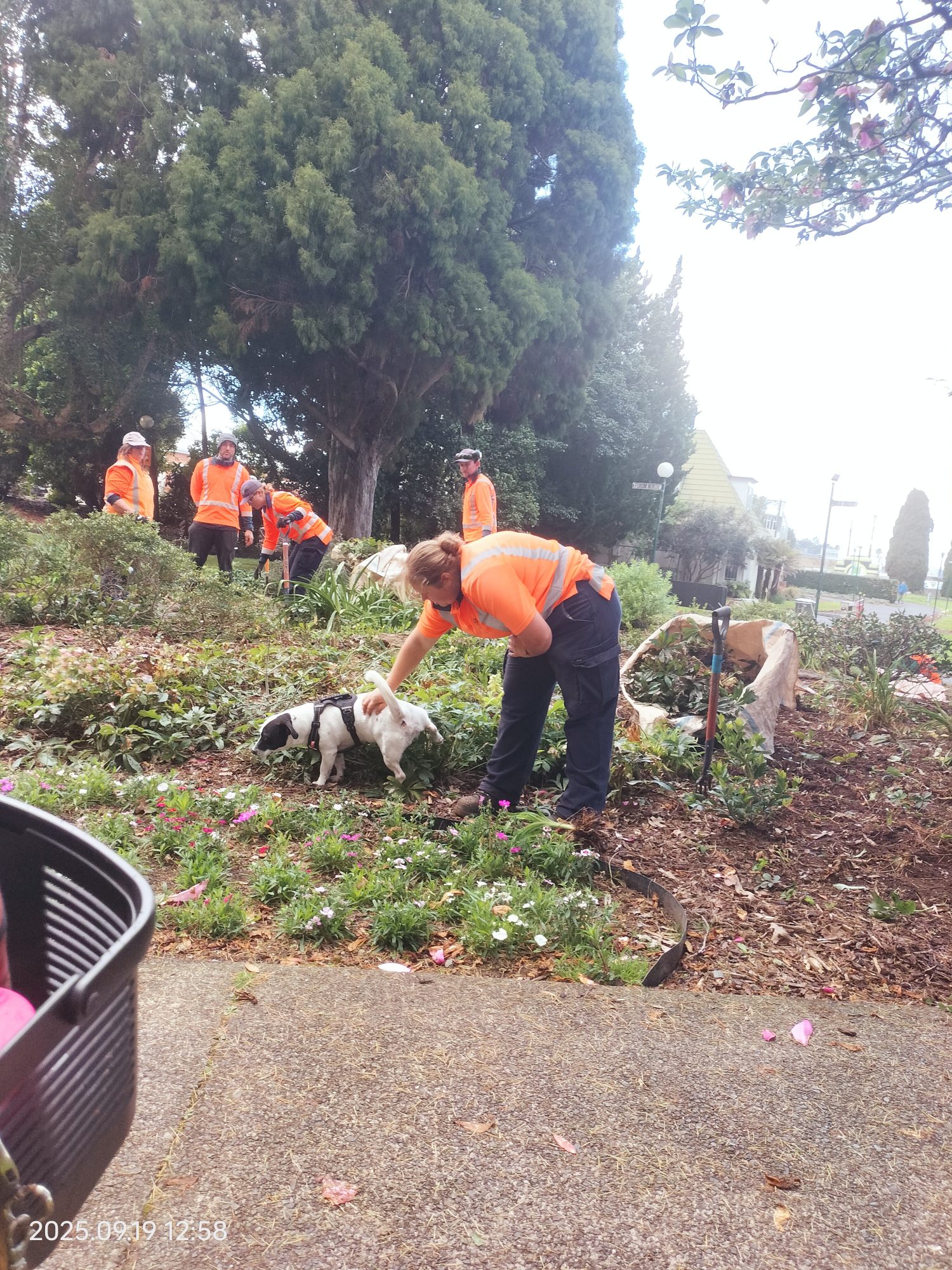
Harvey Dent helping with the planting
Jacqui told me that when they were in Queenstown (October 2025) many people had expressed concern about both the huge number of introduced plants which had become weeds, and the number of pesticides that were being used around that area.
It appears from what we’ve seen so far that Councils are very keen to explore ways in which they can help our butterflies and moths / pollinators / the environment. The MBNZT frequently gets requests for help from residents who want their Council to be more proactive in this regard. So the brief has been expanded to cover:
We have learned so much while we have been sharing information. We’re thrilled that there are people on Council staff who are keen to learn more.
We are supporting a young ecology student at the University of Waikato who is fighting to retain his no-mow area on the kerb (berm) in Hamilton city. Olivier believes it’s important to let nature grow for Aotearoa’s insects. “Plant native, mow less and smarter, and stop spraying. Keep some corners wild” he says.
We’ve also heard from one member who wants to reach out to Council to ensure that the “wild” swan plants at the end of their street are not sprayed or removed – so we are able to liaise with that Council in an official sense.
Take a look at the webpage for “Public Spaces’ on our website.
It was great being involved in tagging this year. This was a new experience for me although the MBNZT has been tagging monarchs from 2007 for thirteen years. I was keen to be involved and help manage the project.
We had two IT professionals who volunteered to set up the program, Travis Nong and Frank Lee, who had never done anything like this before, especially working with Google Maps and JavaScript API (Application Programming Interface). I think we all learned lots of new things with this. The program we’d used ten years ago was no longer available and we had to start from scratch. As a result, we’ve discovered many ways to make improvements to the system for next year before we begin tagging. We need to eliminate as much ‘human error’ as possible, to ensure accuracy in our data being validated.
If this program is to help the monarch butterfly, we have to be as close to 100% accurate as possible, and careful with our data reporting.
In total, 4,362 tagged monarchs were released during the 2025 project, with 257 recorded sightings. Most monarchs stayed close to home, with 129 sightings occurring within 100 metres of their release site. However, 14 individuals made impressive long-distance journeys of over 5km. For an interactive map of all the tagged and sighted monarch butterflies click on this map.
One of the most exciting moments for the team is receiving photos after the system’s initial acknowledgement of a sighting – proof that a tagged monarch has been recovered.
A great example is WAM459, reared and tagged by Copper Hay in Redwood Valley in March, then seen seven months later in Motueka, around 20km away, laying eggs.
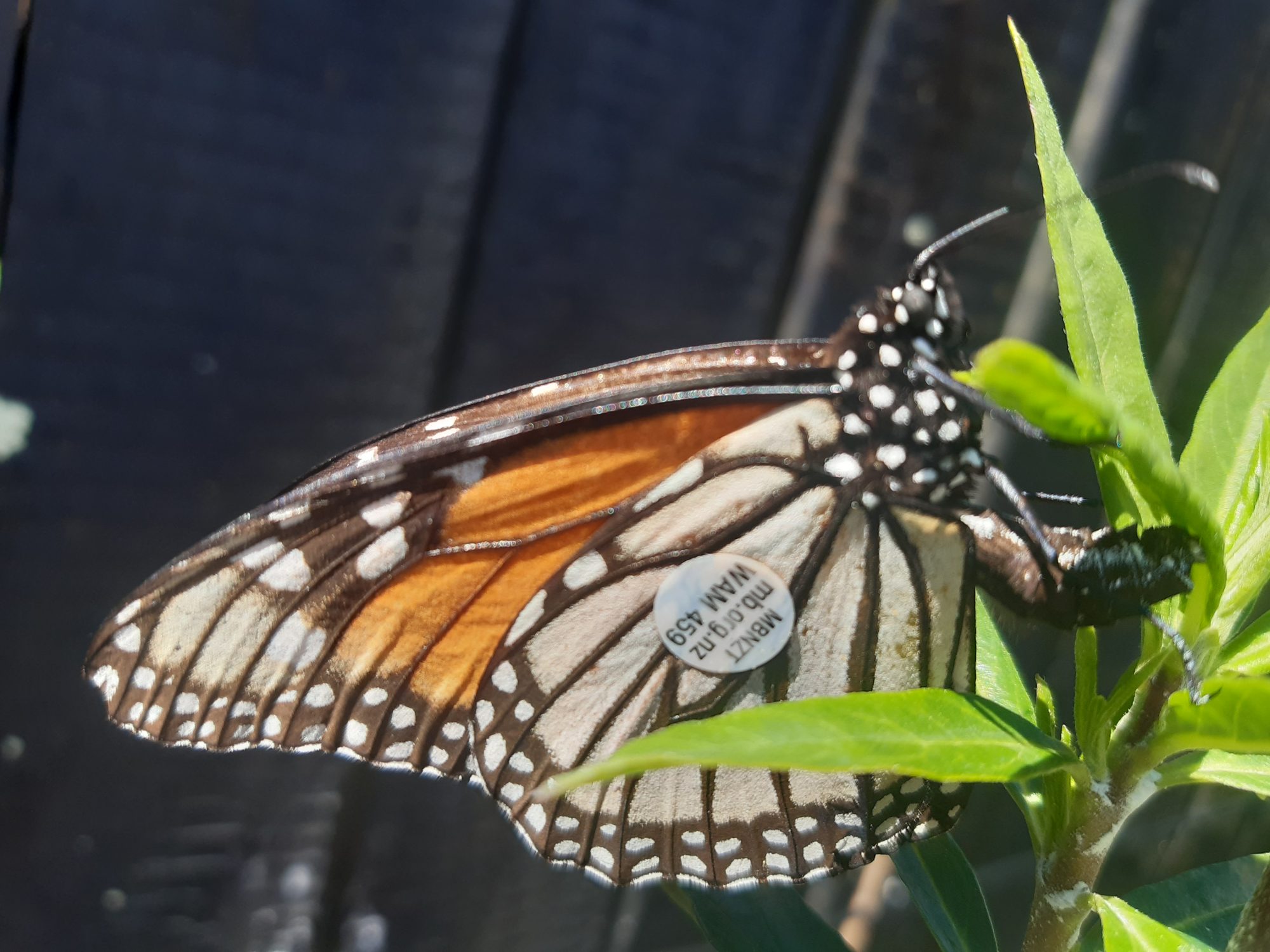
Dr David James, one of the project’s overseeing scientists, noted: “This recovery demonstrates nicely the value of tagging in providing information on monarch longevity as well as movement.” He added that the butterfly was likely an aged female that had spent winter in reproductive dormancy and was now active again – a remarkable insight into monarch life cycles.
The standout traveller? A female monarch that flew from Feilding to Napier – a distance of 140km in just 23 days.
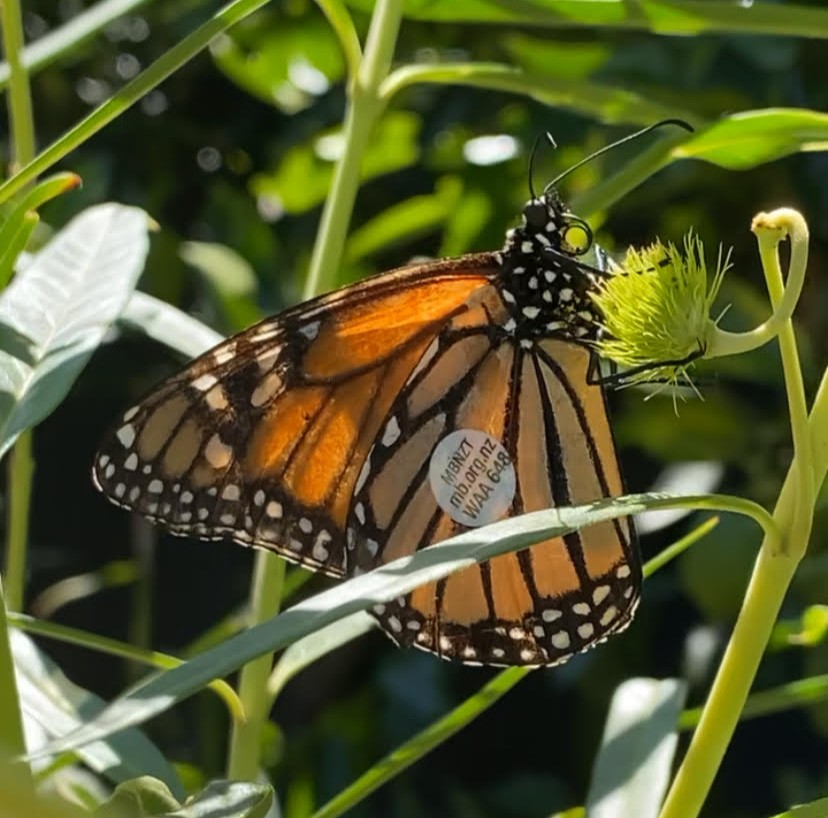
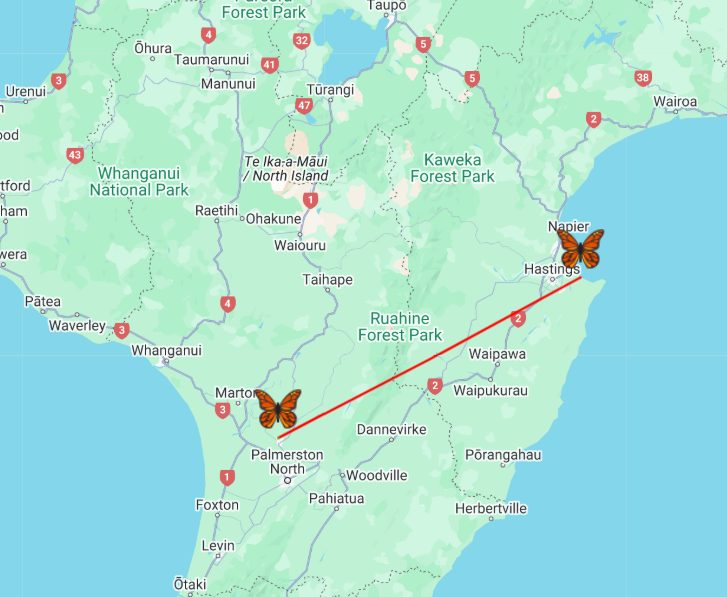
One can’t help but wonder what route she took along the way!
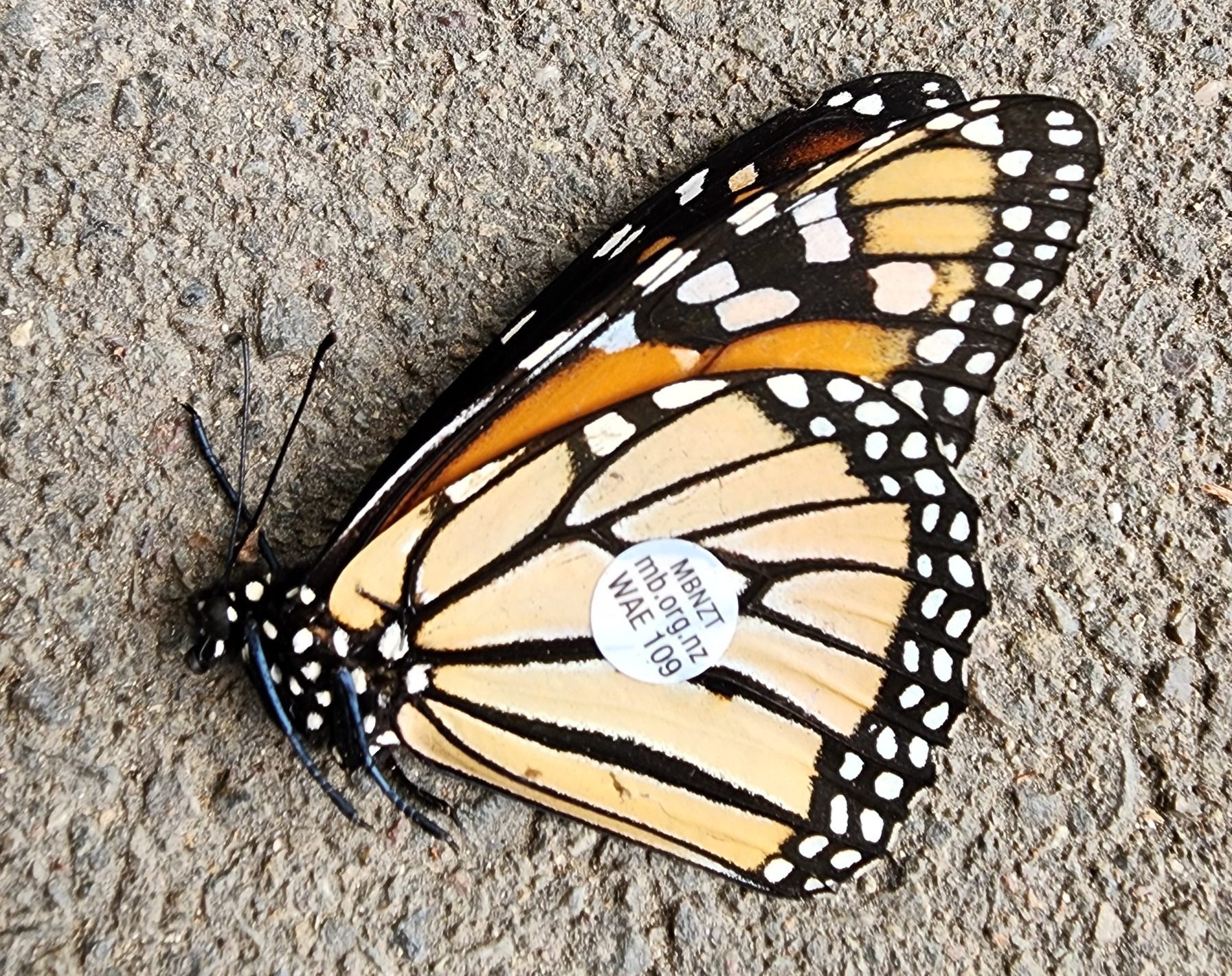
There were also a few mysteries, including one butterfly found deceased well south of its release point. WAE109 was released in Hamilton on 6 April and then found 431kms away in Woodville on 1 May. We are aware of the severe weather in Hamilton over the Easter weekend in April, caused by ex-tropical Cyclone Tam, and wonder if the butterfly was caught up in the wind storm and taken so far off course or did it meet an unfortunate end with a vehicle? These stories remind us just how unpredictable nature can be.
Another interesting finding while summarising the data to date was how most of the male tagged butterflies were located near flowers, and most of the tagged females were found around swan plants.
We still have so much more to learn about these beautiful creatures, hence why accurate data is so vital.
A heartfelt thank you goes out to everyone who participated in the 2025 Tagging Project. Your dedication makes discoveries like these possible.
Thanks to Travis and Frank, our IT professionals.
Big thanks to House of Science for their participation. We look forward to having House of Science members back tagging again in 2026. Two online seminars have already been held with schools encouraging them to plant swan plants and create butterfly habitat, and another to demonstrate tagging will be held in the new school year.
A huge round of thanks to Kiran Thodiyil Kanakambujan who carefully processed and checked that the data collected was valid and useful, and prepared a report for the scientists.
Thanks also to our two overseeing scientists Emeritus Professor Myron Zalucki, at The University of Queensland in Australia, and Dr David James from the University of Washington, for always giving insights and guidance as we go along. It is always appreciated.
We look forward to welcoming you back for an even more refined project in 2026. More information will be in our e-news which goes out weekly, early in 2026.
Map Showing Straight Line Movement
With the Butterfly Discovery Project there has been substantial progress in examining and obtaining boulder copper material for further study, and some preliminary work towards DNA sequencing. In November I visited probably the two most substantial boulder copper butterfly collections on the planet!
First, I visited Brian Lyford in Queenstown and spent an enjoyable afternoon looking through his magnificent and important personal collection. Brian is an exceptionally dedicated lepidopterist and told me that in recent years he has made a special effort to collect copper butterflies wherever he could find them throughout the South Island. His collection is rich in very recently collected material that should be ideal for DNA extraction and sequencing.
Among the significant known South Island populations, the only ones missing from Brian’s collection are the Milford Sound and Chrystalls Beach populations. He told me that he has been to Chrystalls Beach on more than one occasion and failed to find boulder coppers there, so there is extreme concern about the survival of this population. I was able to borrow 38 selected specimens from throughout the South Island for further study.
An important addition to the specimens seen so far (i.e. those currently in NZAC) was Brian’s material from Tiwai Point, Southland. It was interesting to note the remarkable white wing undersides that dominate in this population; however, there was also a Tiwai female with a strongly patterned underside, indicating that even here there is variation within the population.
I was also able to visit the massive collection of copper butterflies at the Otago Museum, built up by Robin Craw, Brian and Hamish Patrick. They have provided me with samples of the Milford Sounds and Chrystalls Beach populations since that time, so I now have a ‘full set’ of the Patrick & Patrick potential species for further study!

Having obtained Tiwai specimens from Brian Lyford’s collection and impressed by their very white undersides, I went ahead and dissected a male from this population. As before, though, I could find no convincing characters in the male genitalia that would separate this population from others at the species level. Indeed, the genitalia appear extremely like those of specimens from the other end of the boulder copper’s range in the central North Island!
In January I removed a leg from each of 35 specimens of boulder copper (a mix of Brian Lyford’s and NZAC specimens collected in the last 20 years) and have placed these legs in labelled vials in the freezer and databased the corresponding specimens, in preparation for future DNA sequencing.
In NZ, as in many other countries, moths are far more numerous than butterflies and are much more varied, hence even learning about the many species in your own area can be a fascinating, enjoyable and addictive hobby for young and old alike.
Moths have been studied far less than butterflies and there is less known about them. This means that any information you record about the moths in your local area can make a real contribution to knowledge and can directly help their conservation.
Since moths are so diverse and numerous, information about them is also valuable because they can indicate how healthy our environment is. For example, a once common species may become increasingly scarce or even locally extinct due to a degraded or even complete loss of suitable habitat. That’s why we are encouraging people of all ages to become citizen scientists and take an active interest in the many types of moths around them, contributing to a better understanding of wildlife, its diversity and the ecosystems they occupy.
Where to look for moths?
Moths can be found almost anywhere, not just in the obvious places such as native forest, coastlines and alpine regions but in gardens, urban parks and patches of wasteground, even in the busiest cities. Some species are specialists and only found in certain habitats, e.g. salt marshes or near certain types of plant, but many are ubiquitous and much more widespread. More than a hundred species could be living in your own back garden or local park, so those are the best places to start looking.
When to look for moths?
Adult moths can be encountered throughout the year, though different species are found in different seasons, with the greatest variety and abundance from spring through to late summer. To increase the chances of observing every type of moth that lives in your area, you will need to look regularly throughout the year. Moths don’t like cold nights, full moons, heavy rain or strong winds so are more likely to be observed on mild, cloudy, still nights.

How to find moths?

Cinnabar moth

Magpie moth

Small thistle moth
As many of you would have read in a recent magazine (Summer 2023-24) a team of volunteers regularly surveys moths at Mt Holdsworth in the Wairarapa, as well as having conducted one-off surveys at Cape Palliser, Castlepoint and Riversdale.
The three Mt Holdsworth surveys undertaken to date (July 2024, October 2024 and December 2024) have resulted in 170 species. Most were found at the lower levels of Mt Holdsworth but 80 species were noted from subalpine and higher attitudes.
This is a baseline survey to ascertain the total species present and it is envisaged that the work will continue over the next several years with the hope that eventually some 350 species or more may be observed.
The Cape Palliser, Castlepoint and Riversdale surveys were to replicate the 2001/2002 study undertaken by Brian Patrick of the Wellington and Wairarapa coastlines, but this original study did not include Castlepoint and Riversdale.
The weather Friday night 10 January was quite good, but on Saturday night 11 January there was simply nothing flying. It wasn't extremely windy or that cold, but the southerly and rain didn't help. They found 177 species compared to Patrick's 2001/2002 total of 208.
One of the species they were hoping to find was the beautiful Broom Flash (Pseudocoremia melinata), see image below.

Photo thanks Christopher Stephens
The biggest success (which they were not actually looking for) was finding the recently described Declana foxii. This is quite a 'discovery' as the species was not previously known here. It had been found once at Putangirua Pinnacles and at Lake Pounui to the west, and is otherwise only known from around Taranaki.

Photo thanks Christopher Stephens
The Castlepoint and Riversdale surveys were the first undertaken in those locations and results are being finalised but they found about 40 species from Castlepoint and 50 species from Riversdale.
The group would welcome more volunteers. Please email Jim at if interested in joining them.
They are finding a similar number of species at Cape Palliser as to the number in the 2001/2002 survey. There are no baseline surveys to compare their results - another reason to do more lepidoptera surveys in the Wairarapa.
If you've scattered swan plant seeds in your garden, are you wondering what is happening to the seedlings? Or, perhaps you're wondering what is nibbling at the epidermis of the stem, sometimes ringbarking the plant and killing it?
It might be a good idea to go out one moonlight night (or take a torch) and see what is happening in your garden. When I did this a few years ago I found so many snails and slugs feasting on my plants during the night. The molluscs were all gathered up and fed to the birds the next day.
This was my haul!

There are many other suggestions for controlling slugs and snails, such as scattering spent coffee grounds, egg shells, sea shells, diatomaceous earth, wool waste or creating beer traps, grapefruit "igloos" and using copper tape. Then there's slug repellents. What method do you use?
At Settlers Lifestyle Village in Albany the residents got together and under the leadership of Doug Robertson, built a butterfly house with the support of management, the Blokes Shed (part of the Menz Shed network) and the community.
Everyone was very busy over the summer months with monarch butterflies being released consistently.

Doug and Sandy Robertson with Jacqui Knight


Bill Larsen, retired engineer, took action into his own hands to save the last of the monarchs the first season. Read his story:

During April and May 2024 our Butterfly House at Settlers continued to cater for caterpillars, and butterflies that eclosed were released. However, the weather for the latter half of April and May was unkind for monarchs.
April and May 2024 in Auckland was notably colder than usual. In April we experienced unseasonable weather, significant temperature fluctuations and unusual weather patterns. May started with a significant cold front and was characterised by unseasonably cold temperatures throughout. Several weather systems brought heavy rain, strong winds, and thunderstorms, particularly in the early weeks. There were instances of temperatures dropping considerably, with daytime highs falling by as much as 8°C in some areas. These conditions were a marked departure from the typical mild autumn weather Auckland usually experiences. (ChatGPT -edited)
On 14 May, another keen butterfly-lover, Vic Edwards, raised concerns about the chrysalides in the butterfly house that were subject to ongoing cold night-time temperatures, and more wet weather was due to arrive the next day. We agreed to immediately transfer chrysalides, as well as one caterpillar in J-stage and two sick-looking caterpillars, to my large incubator.
We found thirteen chrysalides attached to the frame of the butterfly house and six to swan plant leaves. The chrysalides buttoned to the frame were carefully detached using a small wire cutter and placed temporarily in a padded container together with those buttoned to leaves. Later that afternoon, I superglued the thirteen detached chrysalides to string and tied them to the frame in the incubator so that they hung as if they had buttoned themselves.
I obtained cuttings of swan plants and placed them in water-filled jars together with the cuttings that had chrysalides attached. The two sick caterpillars never ate, one became very agitated, but both faded away.

The incubator was placed outside on our balcony during sunny and warmer days and always taken inside at night to ensure the chrysalides would not endure low temperatures.
From 15 May, when the J-stage caterpillar formed its chrysalis, to 2 June when it eclosed (a period of 18 days) there were 18 eclosures and one that died in its chrysalis. In all there were only seven healthy eclosures – two males and five females, the others having defects that disabled them to form and fully expand their wings. These butterflies could not fly, most had difficulty in hanging on to anything and were euthanised.
The J-stage caterpillar demonstrated the success of the incubator as this caterpillar’s metamorphosis was not compromised. However, our overall success rate was a little more than one-in-three, with the low daily temperatures before transfer to the incubator the likely cause of failures.
Even though being a little late in the season, the transfer was worthwhile producing 7 monarchs to winter over. Otherwise, it is probable all would have perished if they had been left in the butterfly house.
Note: When I realised that the butterflies could not climb up the string, I adapted that part of the process.
There are a few well-meaning people out there who are negatively affecting monarch butterflies through their efforts.
We get to see instances of people with sunscreen on their hands handling caterpillars, or covering plants with dirty nets which probably carry all sorts of diseases. Plug-in insect controls, pets with flea collars on, or using seedlings with pesticide residue for food are other concerns.
In California laws have recently been passed against “captive rearing” because it is harmful to the species . “…decreased fitness, poorer overall condition and reduced migratory propensity compared to wild monarchs” has been proven. Handling can also increase stress in monarch larvae and pupae and has the potential to spread Oe.
The migration of monarchs in North America has been negatively impacted over many years by human intervention. You can read more at this link:
Western Monarch Butterfly Conservation Plan
Of course, the NZ government won't introduce laws as monarchs are not endemic but the MBNZT can spread the message about best practice.
From time to time you will see our messages in social media. Please share them and encourage others to adopt best practice too. Here's one:
We receive many requests throughout the year about raising healthier swan plants. I have been picking the brains of some of our horticulturists – although not many profess to be experts on boring old swan plants! If swan plants were roses or popular food crops, no doubt there would have been in depth analysis of the diseases that affect them. But they’re not. So while we monarch lovers can’t identify many of the issues affecting the plants we can at least do what is within our power to raise healthier plants.
If you are starting out encouraging monarch butterflies you will find that most of the plants available in the spring in garden centres are “seedlings”, about 15-30cm tall. There is nothing wrong with that – but do not think these are fully grown swan plants. The seedlings have been started by commercial nurseries over the winter and into the spring and kept protected from aphids and monarch butterflies so they are in great condition when they go on sale. Quite probably insecticides or fungicides have been used in their production.
A large, fully-grown swan plant could be 2 metres tall or even more and having them established before the monarchs return from overwintering is a huge boon. So as you buy or grow your plants, think about them for next year and subsequent years.
In many parts of the country, it is possible to raise swan plants which will last for two or three years. In cooler areas you could try them on the sunny side of the house, under the eaves, but you might need to offer protection from frosts or snow of course. And you could try getting Asclepias incarnata established. This is very successful in colder areas as the shoots appear soon after winter weather retreats, and grow much quicker than any swan plant seedling. It establishes with an underground root system and the patch will get bigger each year.
Here in Auckland, and towards the end of the season I take stock of my swan plants and remove any that do not look healthy: actually, I do this throughout the season, putting branches inside the butterfly house so that the leaves are eaten before I dispose of the bare branches. I do not compost them if I think they may have a plant disease. (A plant disease will not affect the caterpillars but could spread to other plants of course).
I am not well disciplined enough to sow from seed but depend on a very good friend to provide me with seedlings. However, check out the method Gus Evans uses in his guest editorial in the blog. There is no right or wrong way.
And here is a very useful leaflet from Yates about growing swan plants from seed.
Once I have seedlings, I ensure they get a good feed of Nitrogen once a week and I only repot them when there are roots coming out the bottom of the pot. Remember, swan plants are weeds or wildflowers and have not been fussed over or improved by plant breeders over the years, so you should not fuss over them either. There are different ways you can give them Nitrogen. Nitrogen encourages healthy leaf growth.
You could try Tui® Nitrophoska-K or Yates® Thrive Natural Fish and Seaweed, a concentrated plant food. Or sheep pellets, blood meal, diluted human urine (10:1), compost tea, seaweed tea, worm wee. Worm wee makes soil far richer than it could ever be on its own. I have heard that worm castings have five times more nitrogen than regular soil! Unlike chemical fertilisers worm tea will never burn plant roots, no matter how much is applied. If you have access to comfrey or Tithonia diversifolia, these leaves are also rich in nitrogen.
As your swan plants grow it is absolutely natural that the older leaves go yellow and drop off. You will also notice that the stem gets thicker and taller… and there are new leaves at the top. It is fascinating watching the plants grow. When they are about 20cm or so, you might want to pinch out the top of the plant. This will mean that two lateral stems will start growing out at angles, so your plant has just become twice as productive. After those laterals are 10-15cm, you might want to repeat the exercise. Now your plant will provide four times as much food for caterpillars. There is a video on our YouTube channel with some more tips for swan plants as well.
If you see curled leaves or leaves with black spot you can remove them. Do not compost these as you run the risk of spreading fungus or bacteria spores to other plants or into the soil. Diseases can be spread by ants, aphids and passionvine leafhoppers, so control these pests. In ongoing humid weather the problems become exacerbated.
Spots on stems and leaves can be a symptom of a fungal disease. Get in early to start controlling it on young plants. A copper fungicide will kill bacteria on contact. Yates® Liquid Copper is an easy to use, broad-spectrum copper fungicide and bactericide. Check that other copper products are not mixed with an insecticide.
Spray the plants before the monarchs return from overwintering and your plants should stay healthy throughout the season.
You might have heard of the monarch disease referred to as Oe (short for Ophryocystis elektroscirrha) which is carried by female monarch butterflies. As she lays eggs, if she is infected, she will also leave behind spores of Oe on the egg shell. When the caterpillar eats his way out of the egg it will be infected.
The disease can become most apparent when monarchs are raised in cluttered or unhygienic conditions as the disease has a chance to spread. The result will be sick and dying caterpillars, butterflies that struggle to eclose or malformed butterflies.
If you suspect your plant is carrying Oe, left behind by monarchs on the leaves, or other plant diseases, you can spray them with a bleach solution of 1 part of bleach to 19 parts of water. Ensure you buy regular bleach (not with other ingredients such as lemon) and wash the bleach solution off the plant with fresh water after ten minutes.
If you have plants in pots you will need to water them. But in the garden, always water at the base of the plants and invest in sustainable practices to ensure you minimise the need for water. This is not only good for your garden but good for the environment too. I recently watched an excellent series on the soil food web, restoring nature to the soil and highly recommend it so you can understand sustainability in your garden..
Yellowing leaves further up the plant, or stunted growth can be a sign of nitrogen deficiency so keep up the regime of feeding your plants. Do not expect all of your plants to thrive, but if you follow the above ideas you should have more successful swan plants. And feel free to add comments below with your own ideas. As I said, there is no right or wrong way. What will work for me may not work for you. But it is great to learn what others do.
Also, have you checked out the video on YouTube with tips for getting more out of your swan plants?
To give our #sprayfreeleavesplease campaign a boost we’re asking people like you (who don’t like to see monarchs being killed by pesticides) to replace your profile picture temporarily with a meme just like this:

Or this one:

This should get people talking about our #sprayfreeleavesplease campaign!

I’m sure our monarchs will appreciate it!
Select which meme you like best, and save it to any or all of your social media channels.

Paste it anywhere. We don't mind if you decorate the local bus shelter with it!

You might like to design your own meme for your page. I’m sure your friends and family members will want to know what this campaign is all about. Be sure to include the hashtag #sprayfreeleavesplease.

If people want to know more, they can read up all about it here.
Be kept posted about our special offers, events and news weekly. Better yet, become a financial member of the MBNZT