

What We’re Learning from Our 2025 Monarch Tagging Project
It was great being involved in tagging this year. This was a new experience for me although the MBNZT has been tagging monarchs from 2007 for thirteen years. I was keen to be involved and help manage the project.
We had two IT professionals who volunteered to set up the program, Travis Nong and Frank Lee, who had never done anything like this before, especially working with Google Maps and JavaScript API (Application Programming Interface). I think we all learned lots of new things with this. The program we’d used ten years ago was no longer available and we had to start from scratch. As a result, we’ve discovered many ways to make improvements to the system for next year before we begin tagging. We need to eliminate as much ‘human error’ as possible, to ensure accuracy in our data being validated.
If this program is to help the monarch butterfly, we have to be as close to 100% accurate as possible, and careful with our data reporting.
In total, 4,362 tagged monarchs were released during the 2025 project, with 257 recorded sightings. Most monarchs stayed close to home, with 129 sightings occurring within 100 metres of their release site. However, 14 individuals made impressive long-distance journeys of over 5km. For an interactive map of all the tagged and sighted monarch butterflies click on this map.
Fascinating discoveries in the field
One of the most exciting moments for the team is receiving photos after the system’s initial acknowledgement of a sighting – proof that a tagged monarch has been recovered.
A great example is WAM459, reared and tagged by Copper Hay in Redwood Valley in March, then seen seven months later in Motueka, around 20km away, laying eggs.
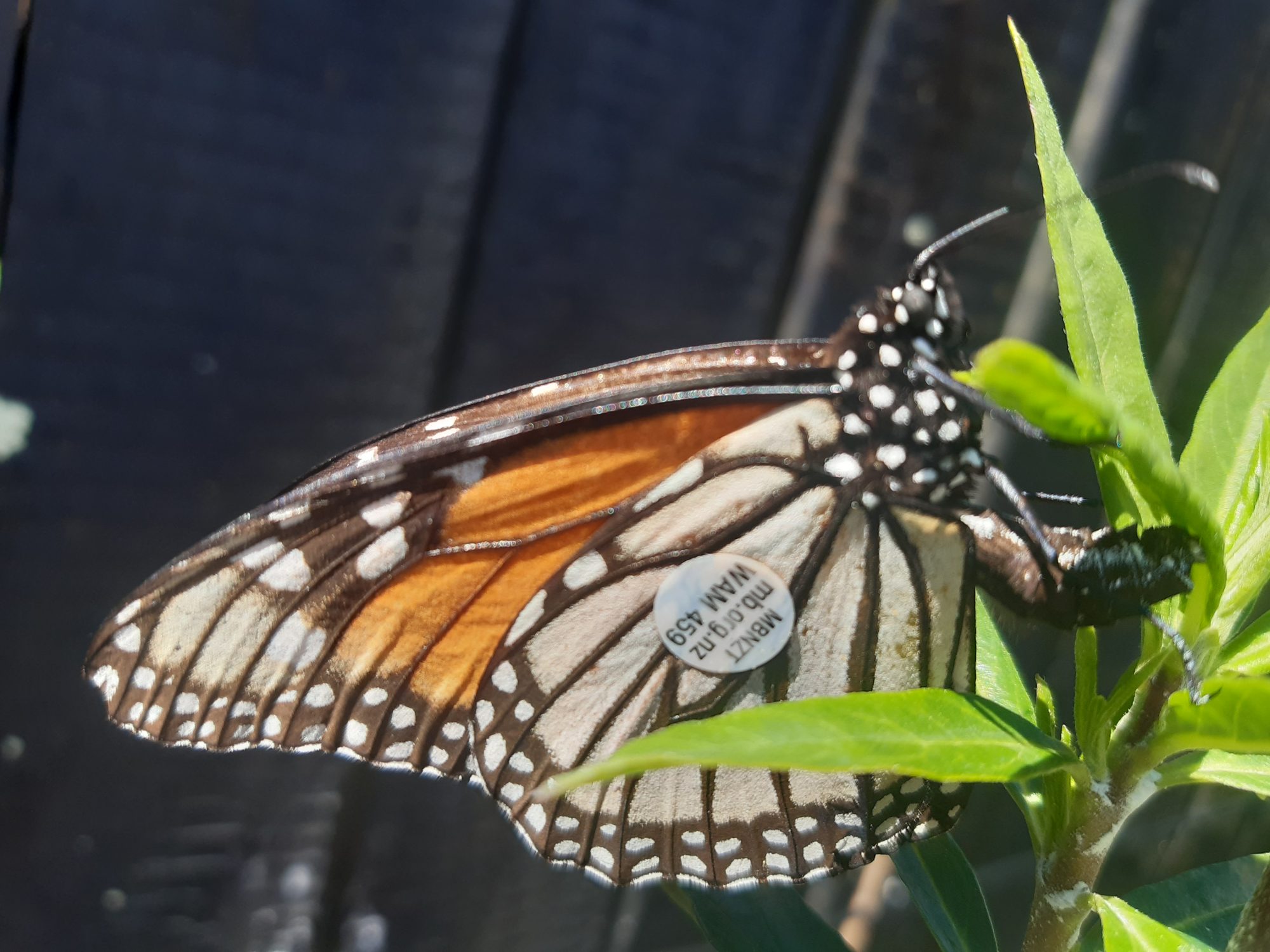
Dr David James, one of the project’s overseeing scientists, noted: “This recovery demonstrates nicely the value of tagging in providing information on monarch longevity as well as movement.” He added that the butterfly was likely an aged female that had spent winter in reproductive dormancy and was now active again – a remarkable insight into monarch life cycles.
By the numbers
The standout traveller? A female monarch that flew from Feilding to Napier – a distance of 140km in just 23 days.
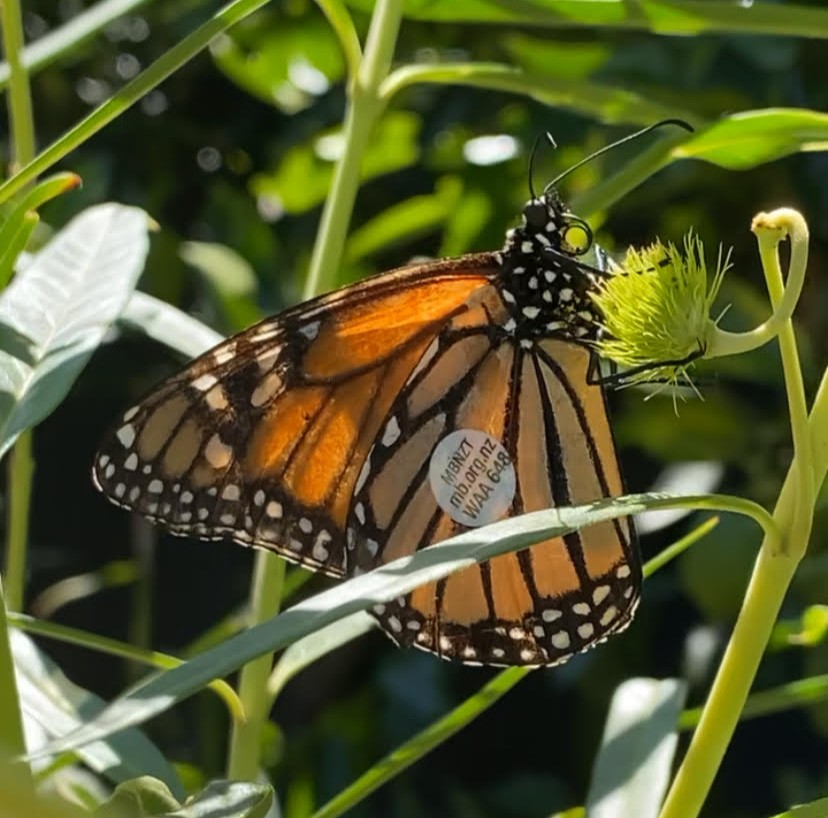
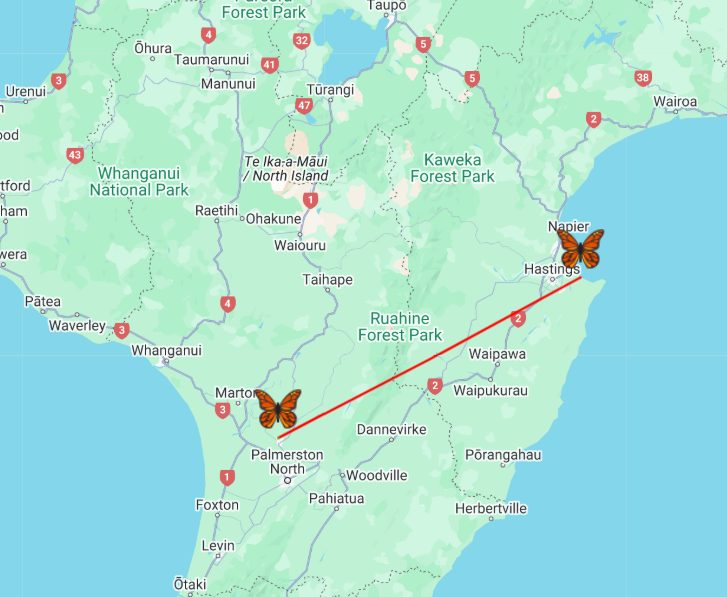
One can’t help but wonder what route she took along the way!
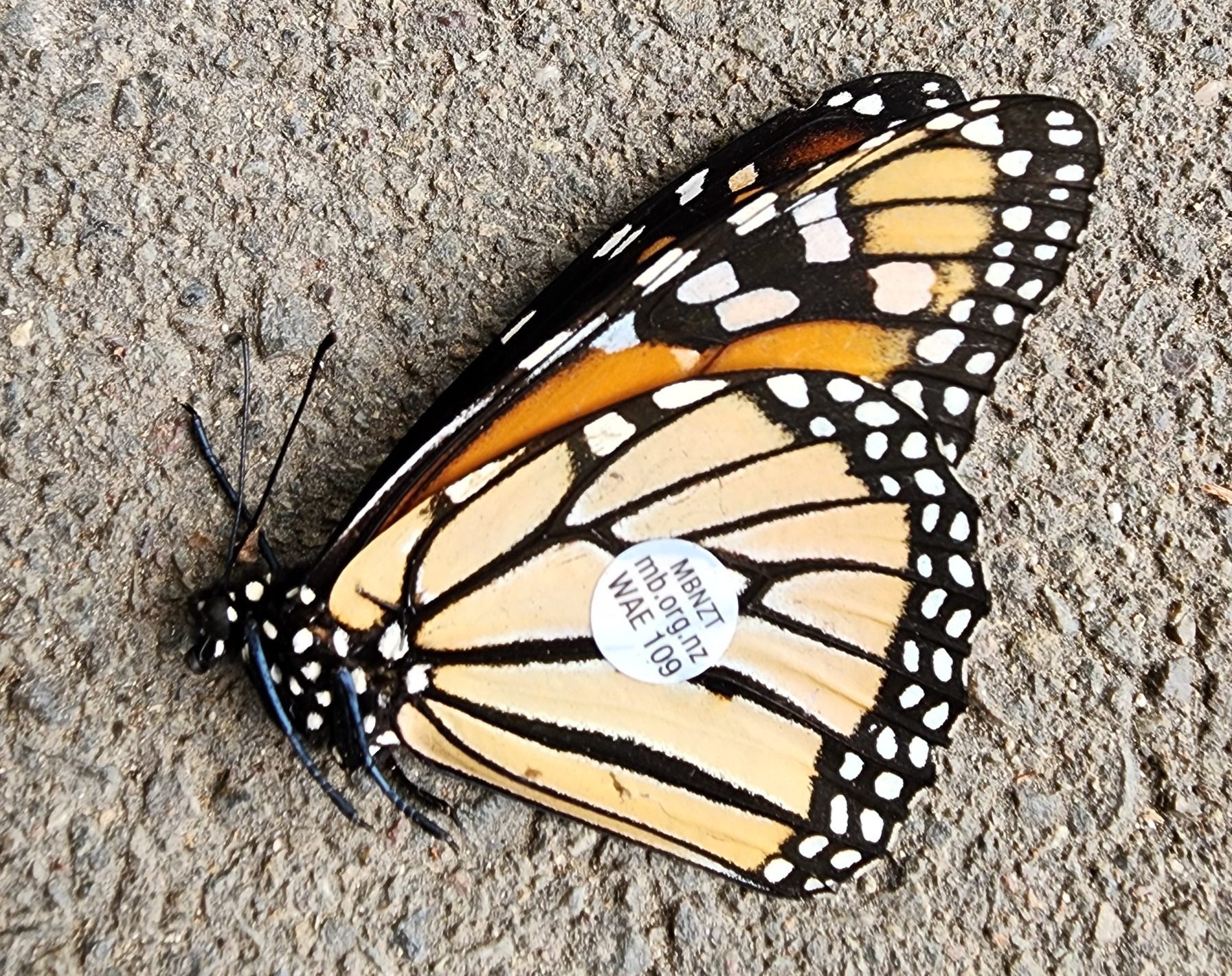
There were also a few mysteries, including one butterfly found deceased well south of its release point. WAE109 was released in Hamilton on 6 April and then found 431kms away in Woodville on 1 May. We are aware of the severe weather in Hamilton over the Easter weekend in April, caused by ex-tropical Cyclone Tam, and wonder if the butterfly was caught up in the wind storm and taken so far off course or did it meet an unfortunate end with a vehicle? These stories remind us just how unpredictable nature can be.
Another interesting finding while summarising the data to date was how most of the male tagged butterflies were located near flowers, and most of the tagged females were found around swan plants.
We still have so much more to learn about these beautiful creatures, hence why accurate data is so vital.
Looking ahead
A heartfelt thank you goes out to everyone who participated in the 2025 Tagging Project. Your dedication makes discoveries like these possible.
Thanks to Travis and Frank, our IT professionals.
Big thanks to House of Science for their participation. We look forward to having House of Science members back tagging again in 2026. Two online seminars have already been held with schools encouraging them to plant swan plants and create butterfly habitat, and another to demonstrate tagging will be held in the new school year.
A huge round of thanks to Kiran Thodiyil Kanakambujan who carefully processed and checked that the data collected was valid and useful, and prepared a report for the scientists.
Thanks also to our two overseeing scientists Emeritus Professor Myron Zalucki, at The University of Queensland in Australia, and Dr David James from the University of Washington, for always giving insights and guidance as we go along. It is always appreciated.
We look forward to welcoming you back for an even more refined project in 2026. More information will be in our e-news which goes out weekly, early in 2026.


Any chance you'll be considering using MOTUS tags in the future?
I'm using a Terra bird monitor which also has a MOTUS tag antenna in it as well. In the USA, they're using these for tracking.
As these devices get more widespread (and I hope they do so much more here to track bird population changes) we'll get more data.
Hi Jesse - that sounds very interesting. We will have to look into them.